BLUEROCK

Projects · proof · estimates · consultation

Web Design for Solar Installers

Help property owners understand fit, verify the installer, evaluate real work, and request a consultation without turning preliminary inputs into promised savings, design, financing, or approval.

Start Your Website

First-screen clarity

  1. 01 · Property and project fit?
  2. 02 · Real installations?
  3. 03 · Qualifications verified?
  4. 04 · Estimate or proposal?
  5. 05 · Request or confirmed consultation?

A home system, commercial portfolio, battery project, and existing-system issue need different paths.

Residential solar

Route homeowners by ownership or authorization, property type, roof and electrical context as known, utility, usage records, objectives, timing, access, storage interest, and consultation availability without promising suitability or savings.

Commercial and portfolio projects

Separate owner-occupied, leased, multifamily, nonprofit, municipal, agricultural, ground-mount, carport, portfolio, procurement, bid, and partner paths with decision-makers, sites, load context, documents, milestones, and qualified roles.

Battery, EV, and energy systems

Explain only supported storage, backup, load management, EV charging, generator, microgrid, or electrification work with verified equipment relationships, electrical scope, operating modes, limitations, permits, commissioning, and service responsibilities.

Service and lifecycle work

Give monitoring issues, existing-system service, inverter or component concerns, roof work, removal and reinstall, expansion, warranty coordination, animal or weather damage, and ownership transfer distinct intake and eligibility rules.

Replace generic green claims with verified projects, current qualifications, transparent models, and real territory.

Real installations—not generic panels

Connect approved images to property type, system type, company role, verified equipment, approximate or exact size only when approved, project stage, roof or site context, battery scope, utility or authority context, and truthful completion status.

Current qualifications and relationships

Publish licenses, insurance, certifications, manufacturer or finance relationships, utility registrations, awards, reviews, years, warranties, and service capacity only from current company-approved records and with accurate jurisdiction and scope.

Responsible estimates

A calculator should identify its date, assumptions, source data, exclusions, rate and escalation inputs, shading or production basis, degradation, incentives, ownership model, and uncertainty. It is an educational estimate—not a proposal, guarantee, or tax advice.

Territory with utility context

State genuine service areas, supported utilities, property and roof types, travel or project thresholds, permitting and interconnection familiarity, scheduling, equipment availability, and commercial reach only when operations support them.

Collect enough context for a useful review—without manufacturing a system design.

  • 1Residential, commercial, nonprofit, municipal, agricultural, multifamily, new construction, ground mount, carport, battery, EV charging, service, expansion, removal and reinstall, or another actually supported request
  • 2Property address or preliminary area, ownership or decision authority, property and occupancy type, roof material, age and work planned as known, usable site or roof areas, obstructions, access, electrical service context, and existing generation or equipment
  • 3Utility and rate plan as known, recent usage or approved bills through a consent and privacy workflow, seasonal changes, planned loads, outage priorities, operating goals, and timeline—without converting them into confirmed design or savings
  • 4Approved roof, electrical, site, drone, plan, bill, interval-data, prior proposal, equipment, warranty, permit, interconnection, inspection, and service documents with defined access, retention, transfer, and deletion rules
  • 5Clear consent before credit, financing, incentive, utility-data, remote imagery, third-party lead, e-signature, or partner workflows; identify who receives data and distinguish prequalification, application, approval, contract, and funding
  • 6Safety and access instructions based on actual operations: no roof access or electrical work by the visitor, no claim that a visible condition is safe, and separate handling for downed conductors, fire, damaged equipment, flooding, or other urgent hazards

Keep request, consultation, evaluation, design, proposal, financing, permit, interconnection, installation, and permission to operate distinct.

  1. 01

    Request

    The customer supplies project type, authority, property, utility, usage and system context as known, goals, access, records, consent, and contact details.

  2. 02

    Review and consult

    The installer confirms territory, service fit, qualified roles, records, utility context, information gaps, consultation type, and the next step separately.

  3. 03

    Evaluate the site

    Authorized personnel review roof or land, structure boundaries, shade, electrical conditions, equipment, access, usage data, hazards, and investigation or trade needs.

  4. 04

    Design and model

    Responsible parties document verified inputs, equipment, layout, production model, storage behavior, assumptions, exclusions, code, utility, permit, interconnection, and lifecycle responsibilities.

  5. 05

    Propose and authorize

    Scope, products, price, incentives as applicable, financing disclosures, schedule, warranties, changes, permits, data permissions, contract, and approvals remain explicit and separate.

  6. 06

    Install and close

    Procurement, access, protection, installation, inspections, utility steps, permission to operate, commissioning, monitoring, records, training, payment, service, and warranty handoff match reality.

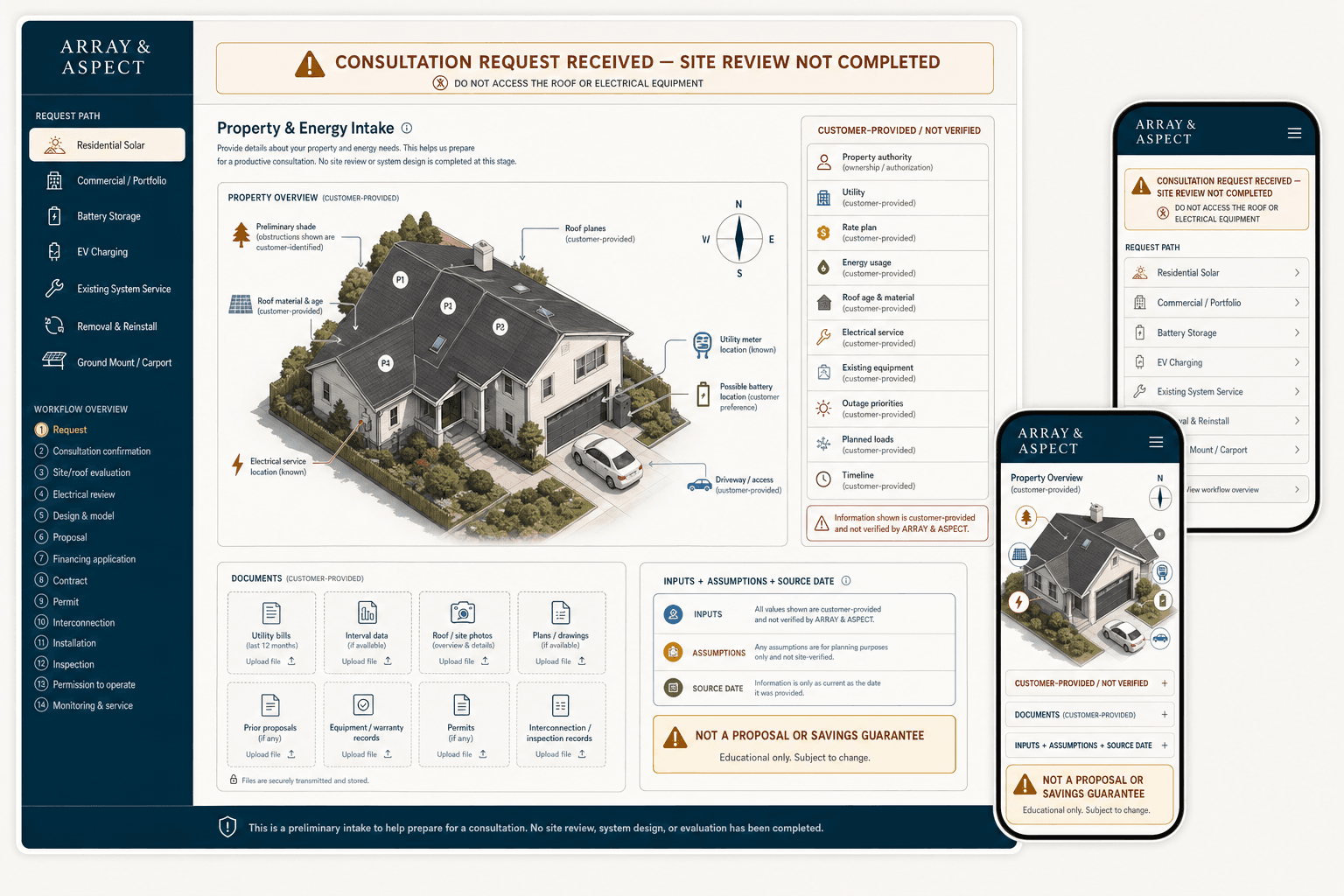
Array and Aspect fictional solar installer website concept with a preliminary roof and energy intake

Original BLUEROCK concept

Array & Aspect makes assumptions visible before any proposal exists.

See a fictional interface for project routing, customer-provided roof and energy context, records, estimate assumptions, safety, responsibilities, and an unmistakable “site review not completed” state.

Fictional design study—not a real company, property, evaluation, design, forecast, proposal, financing decision, approval, installation, warranty, or result.

View the concept

Solar installer website questions

What pages should a solar installer website include?

Most need a focused homepage, genuine residential and commercial paths, storage or related services only where supported, accurate territory, approved projects, verified qualifications, a clear process, consultation requests, service or warranty routing, and contact details. Financing, incentives, calculators, utility, product, and location pages require current evidence and ownership.

Can a solar website show savings and payback estimates?

It can show a clearly labeled educational estimate when inputs, source date, utility rate, usage, production basis, degradation, shading assumptions, financing or ownership model, incentives, uncertainty, exclusions, and update ownership are defined. It should not promise production, savings, payback, eligibility, tax treatment, or future rates.

Can visitors get an instant solar quote?

Only when the system can accurately handle service territory, property and roof data, electrical context, usage, utility rules, equipment, storage, access, design assumptions, incentives, financing, permits, interconnection, availability, and price. Otherwise offer a preliminary estimate or consultation request and confirm scope separately.

How should financing and incentives appear?

Use current, approved information with dates, eligibility boundaries, source links or disclosures, responsible providers, consent, privacy, and the difference between example, prequalification, application, approval, contract, and funding. Do not present tax guidance or guaranteed eligibility.

Will a solar installer website guarantee leads or rankings?

No. It can improve technical access, service clarity, local and utility relevance, verified evidence, mobile contact, and request quality. Competition, proximity, reputation, policy, rates, financing, season, capacity, pricing, promotion, and follow-up also affect outcomes.
Build the website around verified installations, responsible estimates, qualified workflows, and honest consultation status.

Start Your Website