Storm or active damage
Show the verified contact path, hours, territory, supported work, and what happens next. Do not promise emergency response, arrival, temporary protection, insurance coverage, or repair before review.
Storm and planned paths · real project proof
Help property owners and project teams confirm service and location fit, evaluate verified work, and request the right inspection, estimate, or commercial conversation.
First-screen clarity
Request architecture
Show the verified contact path, hours, territory, supported work, and what happens next. Do not promise emergency response, arrival, temporary protection, insurance coverage, or repair before review.
Collect property, observed condition, roof context, timing, access, and contact details for inspection or estimate review without determining cause, scope, system, or price online.
Qualify facility, system, area, leak or project context, access, operations impact, documentation, timing, and the responsible property or facilities contact.
Route new construction, metal, low-slope, restoration, coatings, gutters, exteriors, or other actual capabilities through the appropriate bid or project process.
Proof before promises
Connect approved photos to real roof type, service, scope, company role, and appropriate location precision. Stock or generated imagery must not appear as completed work.
Publish licenses, insurance, bonding, certifications, memberships, manufacturer relationships, awards, and experience only from current approved records.
State genuine service areas and operational limits. Useful local pages need distinct information and proof—not repeated copy with a different city name.
Explain actual workmanship, manufacturer, material, registration, transfer, maintenance, exclusion, and claim terms without collapsing them into a universal promise.
The request should help the team route and prepare for review while keeping safety, cause, coverage, scope, system, price, and acceptance outside the marketing form.
Claims and estimate boundaries
The site may explain the company’s actual documentation and coordination process, but should not promise coverage, claim approval, settlement, deductible treatment, policy interpretation, or legal representation.
An online request is not an inspection, diagnosis, accepted project, final scope, price, schedule, material selection, permit result, warranty, or completed contract.
Describe real services and next steps without manufacturing urgency, implying hidden damage, using unsupported weather events, or presenting a marketing form as safety guidance.
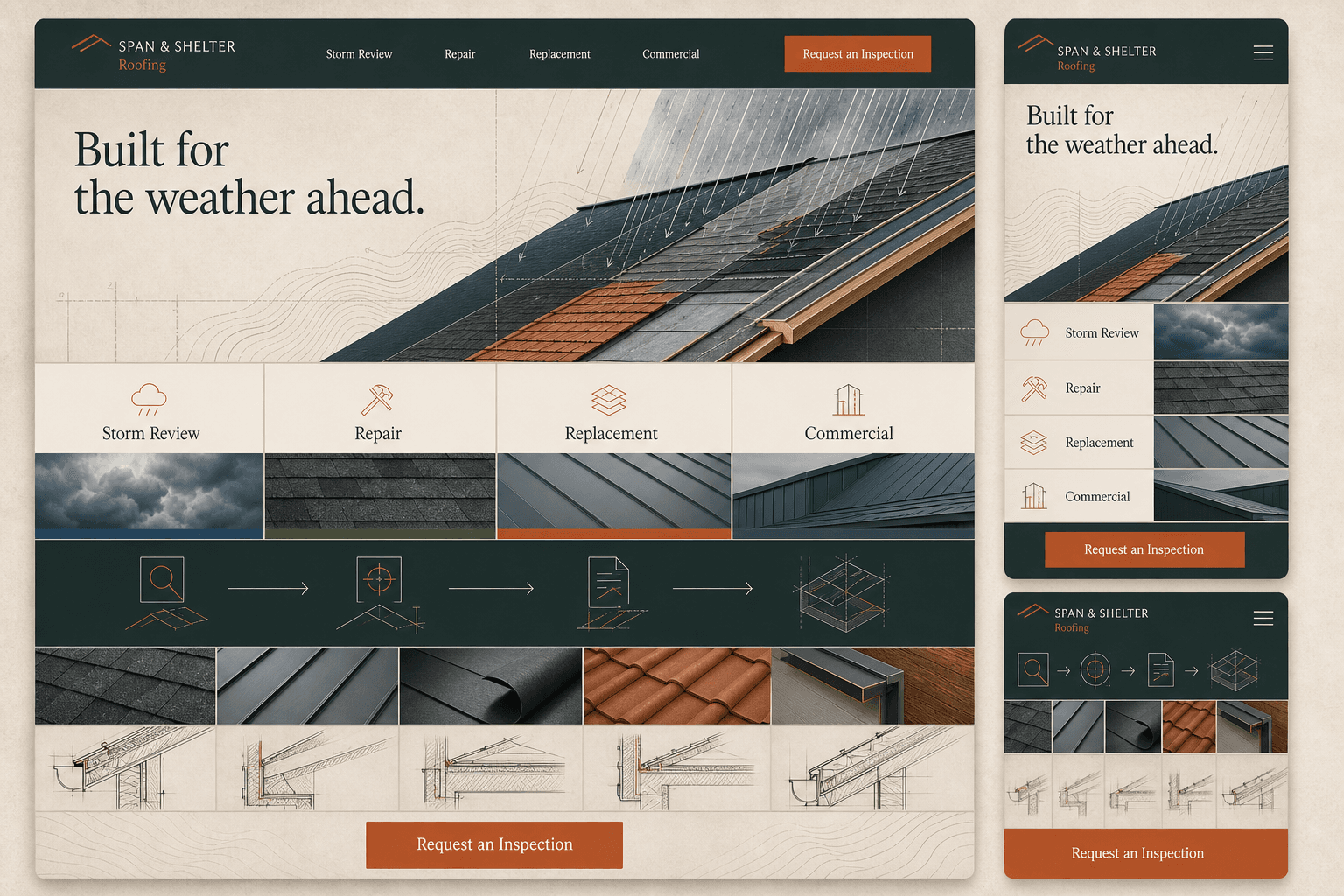
Original design study
Span & Shelter separates storm review, repair, replacement, and commercial paths without presenting generated visuals as completed work or promising an insurance outcome.
Explore the full conceptFAQ
Most need a focused homepage, distinct service pages, accurate service-area information, about or trust content, verified qualifications, approved project evidence, and clear storm, repair, replacement, and estimate paths. Commercial, maintenance, systems, financing, insurance-process, careers, locations, and resources should be added only when supported.
Separate pages are useful when both services are genuinely offered and have distinct customer questions, process, proof, systems, or search intent. The website should not decide which service a property needs before a qualified review.
It can accurately describe the contractor’s real documentation and coordination role. It should not interpret a policy, promise coverage or approval, predict a settlement, waive or absorb a deductible improperly, or imply legal or public-adjusting services the company is not authorized to provide.
A preliminary range or measurement-assisted tool may be scoped when its inputs, data source, assumptions, exclusions, privacy, geographic limits, validity, and human-review process are clear. It should not be presented as a final scope, contract, material decision, or guaranteed price unless the operation truly supports that result.
No. It can improve service clarity, technical access, local relevance, mobile contact, project proof, and request routing. Competition, proximity, reputation, authority, storm activity, seasonality, availability, pricing, promotion, and follow-up also affect results.
For budget planning, compare the roofing website cost guide with our current website starting scope.
Bring the real services, systems, properties, areas, qualifications, project evidence, estimate process, warranty terms, and request workflow.
Start Your Website