General contractors
Explain residential, commercial, public, or other real project types, delivery approach, geographic fit, and the role the company actually performs.
Websites for contractors and construction companies
Show what you build, where you work, which projects fit, and why the visible proof belongs to your company—then give the right prospect a useful next step.
Start with the contractor model
Explain residential, commercial, public, or other real project types, delivery approach, geographic fit, and the role the company actually performs.
Build around the specific trade, systems, certifications, emergency or planned work, customer type, and service territory.
Organize sectors, capabilities, projects, preconstruction, delivery methods, team, and qualifications for buyers evaluating larger work.
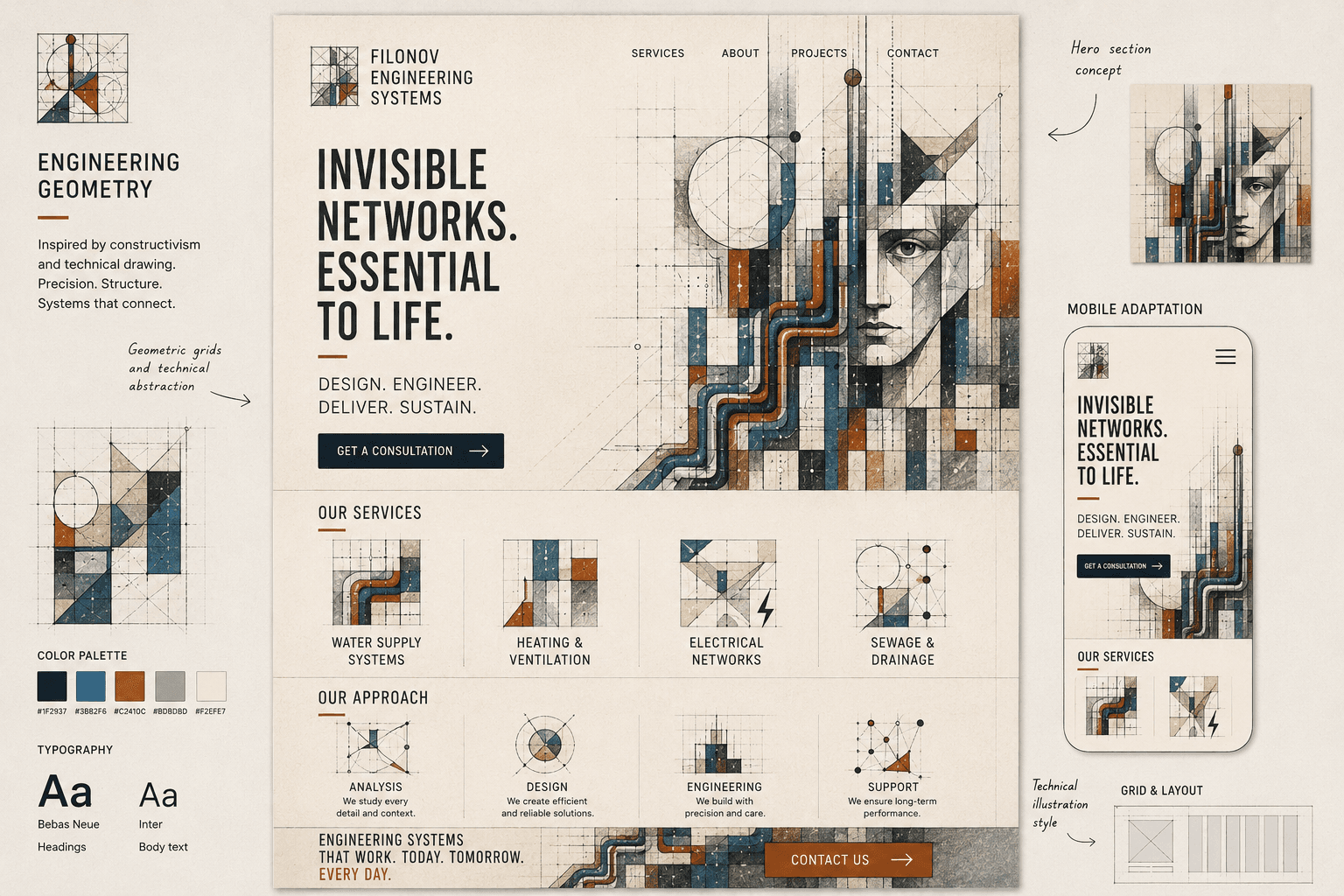
Specialty contractor concept
A constructivist-inspired direction for a fictional building-systems firm, using technical geometry to organize water, heating and ventilation, electrical, and drainage capabilities.
Proof architecture
Use owned, approved photographs and assign each image to one project, service, or process. Do not reuse supplier or competitor work as portfolio proof.
Publish licenses, insurance context, certifications, memberships, safety information, bonding, awards, and years only when current and approved.
Describe where the company actually works and the types of projects it will travel for. Avoid thin city pages that only swap location names.
Ask for project type, location, timing, scope, and contact details appropriate to the estimator—without presenting a form submission as an accepted bid or scheduled job.
Project case fields
A useful form can collect project type, location, timing, scope, budget context when appropriate, and contact details. Its confirmation should say the request was received—not that work, price, availability, or a site visit has been accepted.
FAQ
Most contractor websites need a focused homepage, distinct service or capability pages, service-area information, an about or qualifications section, a project portfolio, and a clear contact or estimate path. Careers, sectors, locations, emergency service, and resource pages should be added only when the business and content justify them.
A dedicated page is useful when the service is real, materially distinct, supported by specific information and proof, and searched or evaluated separately. Pages should not be created by repeating the same copy under dozens of service and city combinations.
Yes, when the company owns or has permission to use the images and the client, location, project, and claims are presented appropriately. BLUEROCK will not treat unverified stock, supplier, or third-party work as completed-project evidence.
Simple qualification or range tools may be possible for a well-defined service, but a website should not imply a binding estimate when site conditions, plans, materials, permits, labor, exclusions, or professional review can change the scope. The workflow must be approved by the contractor.
No. A website can improve service clarity, local relevance, project proof, technical access, measurement, and inquiry handling, but demand, competition, reputation, proximity, authority, pricing, availability, and follow-up also affect results.
Tell BLUEROCK what you build, where you work, which projects fit, what proof can be published, and how estimates are reviewed.
Start Your Website