Urgent service
Show the verified number, actual hours, coverage, eligible work, and after-hours process. Do not promise immediate dispatch, diagnosis, restoration, or arrival.
Service fit · verified proof · safe routing
Help homeowners, property teams, and project partners confirm service and location fit, understand the next step, and contact the electrical company through a workflow it can support.
First-screen clarity
Request architecture
Show the verified number, actual hours, coverage, eligible work, and after-hours process. Do not promise immediate dispatch, diagnosis, restoration, or arrival.
Route troubleshooting, panels, lighting, wiring, generators, inspections, and other real services through the company’s approved call, estimate, or scheduling process.
Collect facility or project type, location, scope, schedule, plans or documentation process, access, and the responsible property, operations, or site contact.
Explain actual charger, service, load, equipment, incentive, permitting, utility, and installation capabilities without promising compatibility, approval, savings, or scope before review.
Proof before claims
Publish license, insurance, bonding, certification, membership, safety, manufacturer, and experience statements only from current approved records.
Connect approved images to the real service, property or project type, company role, and appropriate location precision. Never present stock work as completed work.
State genuine coverage and meaningful limits. Useful location pages require distinct local service information and proof—not city names inserted into duplicate text.
Explain estimates, site visits, plans, permits, utility coordination, inspections, equipment, materials, exclusions, change handling, and next steps only as the company actually manages them.
Safety and operations
A marketing page or form should not tell a visitor that an electrical condition is safe, diagnose the cause, prescribe work, or replace emergency and utility guidance.
Office hours, call answering, urgent response, technician dispatch, appointment availability, restoration, and arrival are different claims and must be written separately.
Booking, call tracking, CRM, field-service, financing, rebate, and estimate tools need defined ownership, permissions, data handling, errors, confirmations, and tested fallback behavior.
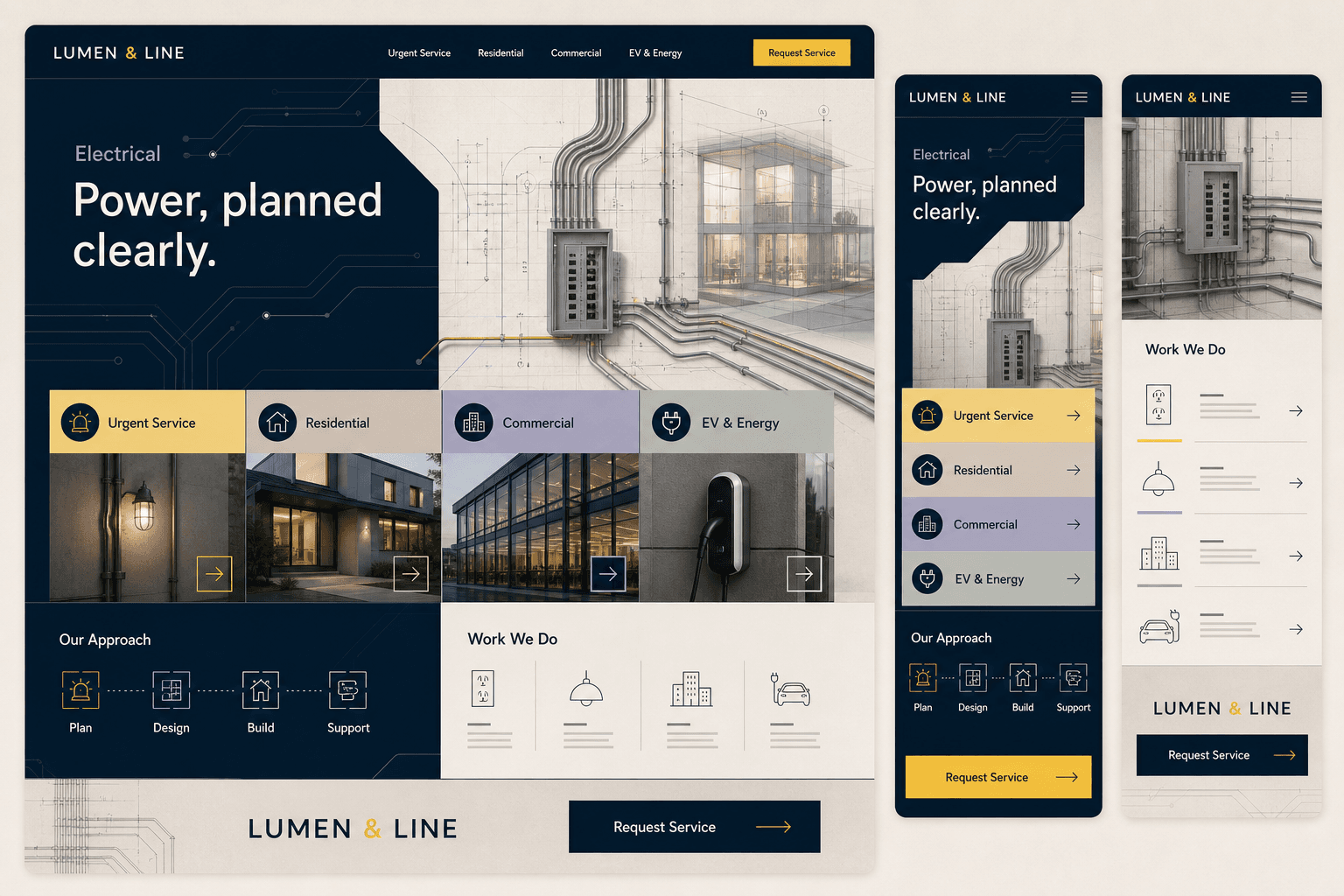
Original design study
Lumen & Line separates urgent, residential, commercial, and EV or energy requests inside a precise architectural identity. It is clearly fictional and makes no claims for a real contractor.
Explore the full conceptFAQ
Most need a focused homepage, distinct service pages, accurate service-area information, about or trust content, verified qualifications, approved project evidence, and clear urgent and planned contact paths. Commercial, construction, EV charging, generators, financing, careers, locations, and resources should be added only when supported.
A separate page is useful when the company genuinely offers the service and it has distinct customer needs, scope, proof, questions, or search intent. Do not create large sets of nearly identical service-and-city pages solely to increase page count.
Only from current company-approved records, with the correct business name, jurisdiction, credential type, identifier or display rules, scope, and expiration context where applicable. The site should not imply that a credential covers work or locations it does not cover.
A request or booking flow can be scoped when services, territories, duration, technician or crew rules, availability, confirmations, cancellation, privacy, and fallback are defined. The site should not display a confirmed appointment unless the operating system can honor it.
No. It can improve service clarity, technical access, local relevance, mobile contact, proof, and request routing. Competition, proximity, reputation, authority, demand, availability, pricing, promotion, and follow-up also affect results.
Bring the real services, property types, areas, hours, qualifications, project evidence, estimate process, and supported systems.
Start Your Website