Qualified quote requests
Give shippers a direct path to share lanes, freight type, timing, and contact details.
Websites for trucking and logistics
Custom websites for carriers and logistics businesses that need to earn trust, explain real capabilities, recruit drivers, and turn visits into useful conversations.
See the evidence behind these priorities in our 2026 study of 100 trucking company websites.
New website or redesign · Mobile-first · Built and measured by BLUEROCK
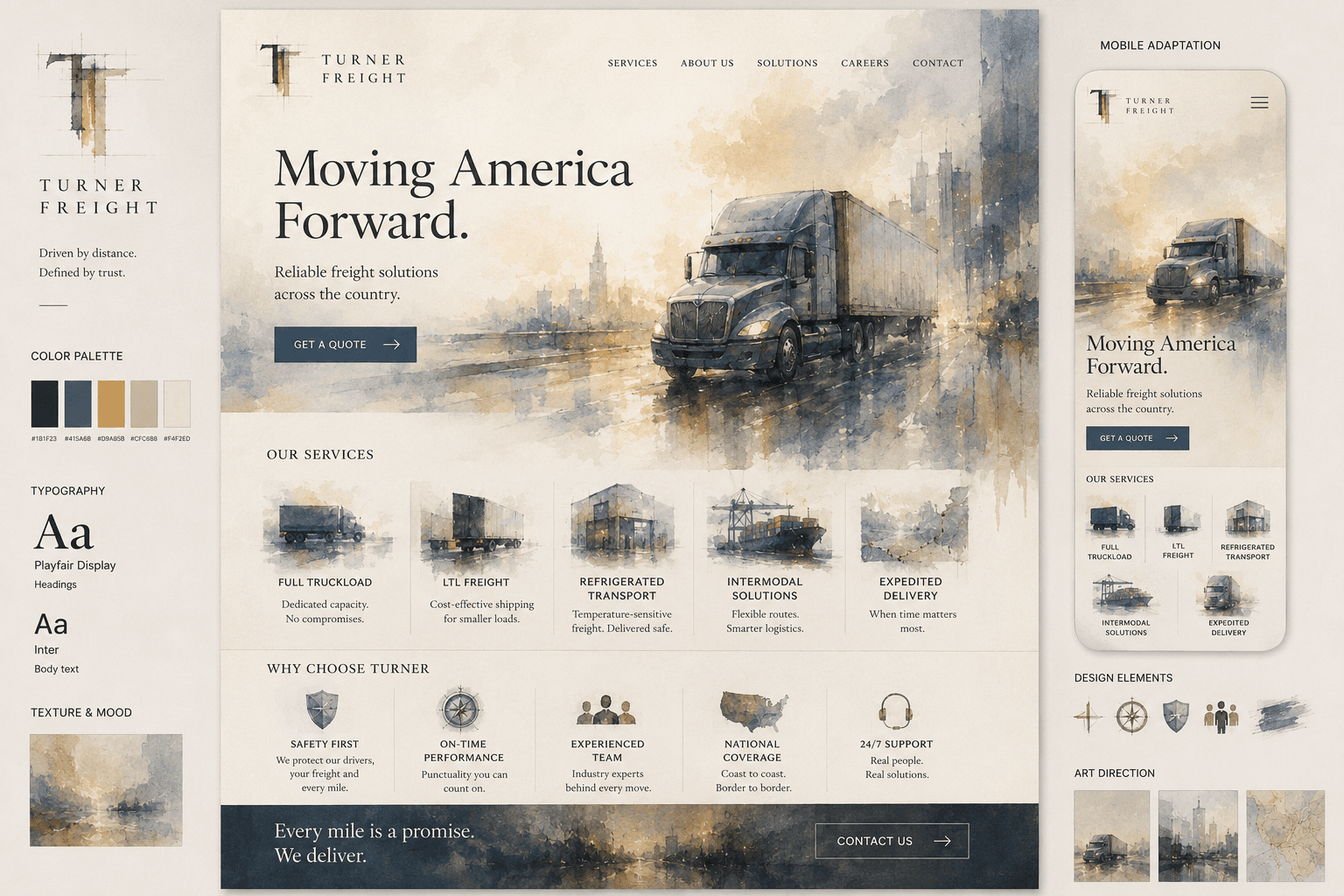
Original BLUEROCK concept
Turner Freight — fictional design study, not client work
Built around the operation
A shipper checking capacity, a driver looking for work, and a partner verifying your company should not be pushed through the same generic page.
Give shippers a direct path to share lanes, freight type, timing, and contact details.
Separate hiring from sales so company drivers and owner-operators reach the right next step.
Explain equipment, service areas, lanes, and freight capabilities without making visitors hunt.
Present verified authority, insurance, safety, experience, and partner information where relevant.
Concept study
An original visual exploration showing how an industrial freight brand can feel established and distinctive without relying on a generic truck-and-highway template.
What is included
The scope is selected around your actual sales, operations, and recruiting needs. We do not add portals, maps, integrations, or claims simply because competitors have them.
Custom design shaped around your operation and brand
Mobile-first layouts for customers and drivers on the road
Service, equipment, lane, and coverage-area structure
Quote-request and driver-application pathways
Technical SEO, metadata, sitemap, and structured data
Performance, accessibility, analytics, and launch checks
Process
We learn what you haul, where you operate, who you need to reach, and what a qualified inquiry looks like.
We explore two distinct creative approaches before committing the full website to one direction.
We organize services, proof, recruiting, and conversion paths into a fast responsive experience.
We validate forms, analytics, metadata, mobile behavior, redirects, and search-engine access before launch.
Pricing and scope
A focused carrier site and a multi-audience logistics platform are different projects. Price and timing are confirmed after we understand the content, forms, recruiting flow, integrations, and launch requirements.
You receive a defined scope before work begins—without invented discounts or a low headline price that excludes the essential pieces.
Request a Project Review Read the trucking website cost guideFAQ
The cost depends on page count, content, quote or application workflows, integrations, photography, and whether the project is a new build or redesign. BLUEROCK confirms scope before giving a fixed proposal; we do not advertise a placeholder price that changes after the conversation.
Most trucking businesses need a focused homepage, services or freight capabilities, equipment or fleet information, coverage or lanes, about and trust information, driver recruiting when applicable, and a clear quote or contact flow. The final structure should match the real operation rather than a generic checklist.
Yes. Those should normally be separate pathways because a shipper, company driver, and owner-operator arrive with different questions. We can build focused forms and connect appropriate third-party systems after confirming the workflow and data requirements.
Yes, but their websites should not be copies of a carrier website. We adapt positioning, content structure, calls to action, trust signals, and integrations to the actual business model.
Every build includes a crawlable structure, page-specific metadata, canonical URLs, sitemap support, structured data where appropriate, internal links, and mobile performance work. No agency can honestly guarantee a ranking, but the technical and content foundation will be built for discovery and measurement.
Before requesting a quote, compare the 2026 trucking website scope and cost guide with our current website starting scope.
Different business model
A broker website needs different trust signals, audiences, and conversion paths than a motor carrier website.
One truck or a small operation
Start with a credible source of truth for your real equipment, freight, coverage, and contact details—not a site designed to imitate a large fleet.
Driver recruiting
Show current job facts clearly, separate interest from a formal application, and connect the right recruiting system without turning the carrier homepage into a job board.
Tell us what your company does, who the website needs to reach, and what should happen after someone visits.
Start Your Website