BLUEROCK Research · Flagship Study #1
We Analyzed 100 Trucking Company Websites — Here's What We Found
BLUEROCK reviewed 100 public U.S. trucking and transportation company websites on August 15, 2026, using a locked FMCSA-based sampling method and a consistent 51-field codebook. Only 8 of 100 sites presented a prominent quote CTA, 18 of 100 offered a public driver-application path, and 49 of 100 showed a primary action above the fold in our mobile test. At the same time, 77 of 100 displayed a homepage phone number and 78 of 100 clearly described their services. The results identify common gaps in shipper conversion, recruiting, trust, and mobile usability without judging company operations or claiming that any feature causes more conversions.
Key findings
The clearest gaps appeared in quoting, recruiting, and public proof.
92 of 100 (92%)
did not show a prominent quote CTA in the initial viewport or primary navigation.
82 of 100 (82%)
did not provide a public online driver-application path.
51 of 100 (51%)
had no primary business action visible above the fold in the mobile test.
73 of 100 (73%)
did not present customer or partner testimonial content.
77 of 100 (77%)
showed a phone number on the homepage.
78 of 100 (78%)
clearly named transport services, freight types, equipment capabilities, or operating modes.
Methodology
The methodology was locked before website feature collection. A documented version change narrowed the reproducible website-bearing frame before outcomes were calculated.
Sampling frame. We froze the FMCSA Company Census File, filtered active U.S. authorized-for-hire property carriers, retained records with a non-consumer corporate domain in the public FMCSA contact record, and ranked candidates using SHA-256 with a recorded seed. Domains were independently resolved and checked for company identity and trucking/transportation relevance.
Collection. We coded 51 observable fields covering basic website quality, commercial conversion, driver recruiting, trust, UX, and performance. Every field stores a value, inspected URL, timestamp, and evidence note. Unknown values were not counted as “no.”
Mobile lab. Browser checks used local Google Chrome at 390×844 CSS pixels. LCP and CLS are lab observations, not field Core Web Vitals. PageSpeed quota was unavailable, so no mobile performance score is reported.
Privacy. Public names, personal emails, employee phone numbers, driver data, and login-gated information were not included in the published dataset. The downloadable file is anonymized.
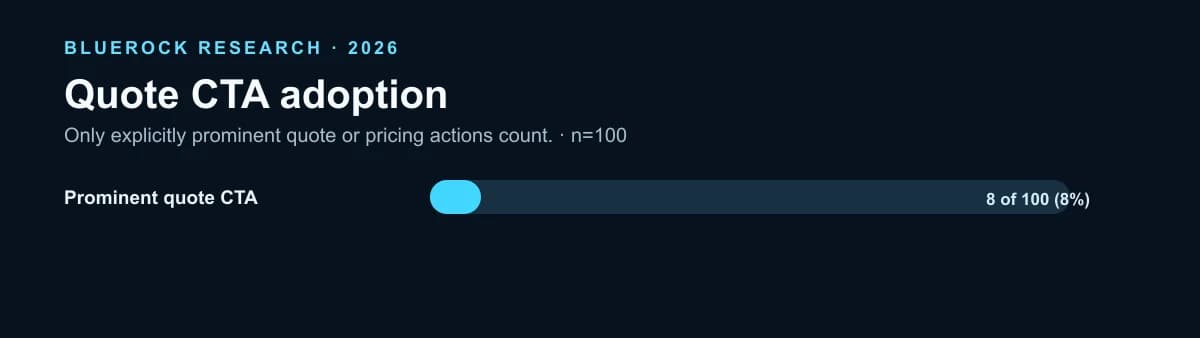
Finding 1: quoting was rarely positioned as a primary action.
A prominent quote CTA appeared on 8 of 100 (8%) sites. A separate quote form was found on 21 of 100 (21%) sites, showing that form availability and clear promotion were not the same thing.
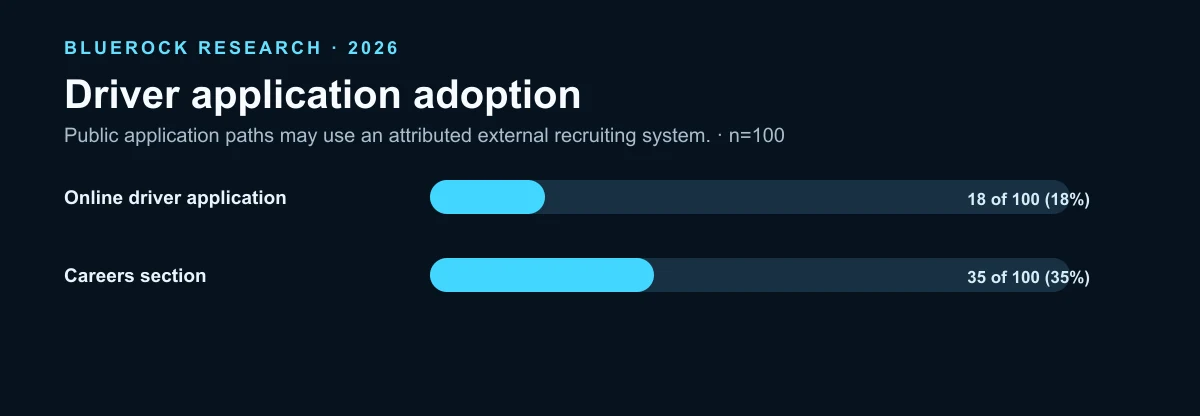
Finding 2: careers pages did not guarantee an application path.
Careers content appeared on 35 of 100 (35%) sites, while 18 of 100 (18%) offered an application path. Among sites with a careers section, 15 of 35 had a driver application; among sites without one, 3 of 65 still linked directly to an application.
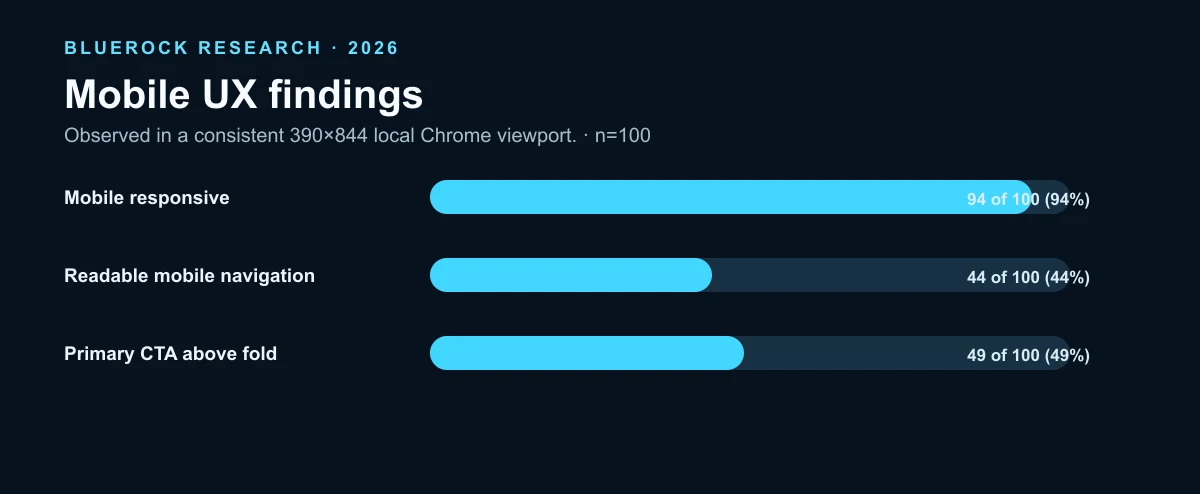
Finding 3: responsive layouts did not always surface a next step.
Mobile responsiveness was observed on 94 of 100 (94%) sites, but only 49 of 100 (49%) exposed a primary action above the fold. In this sample, mobile responsiveness was not positively associated with above-the-fold CTA presence (phi −0.089; Fisher's exact p=0.4316).
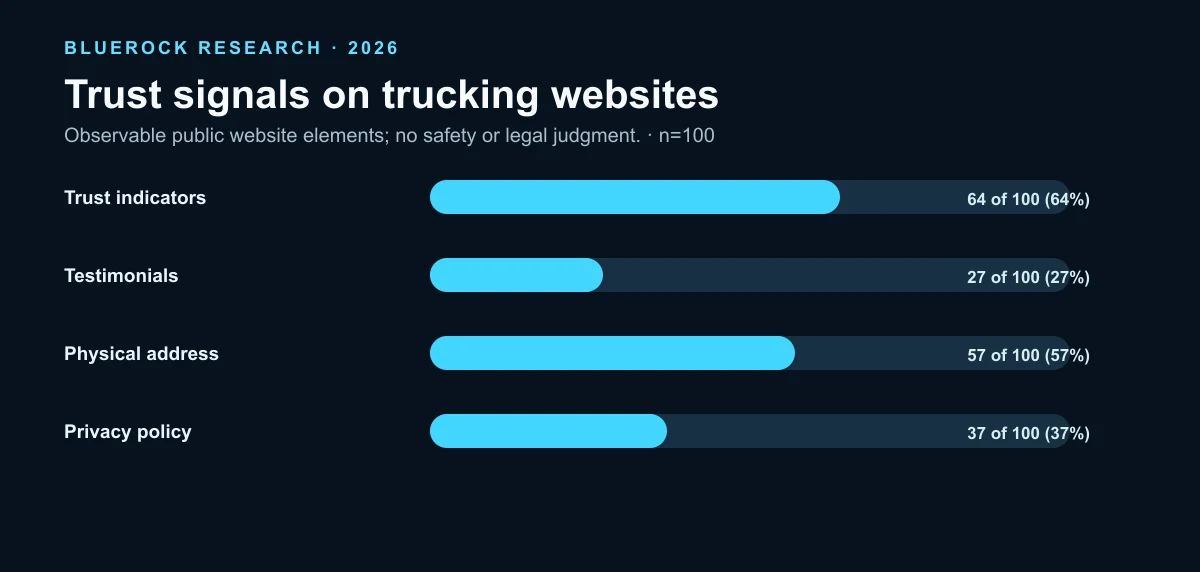
Finding 4: trust signals were uneven.
Customer or partner testimonials appeared on 27 of 100 (27%) sites, a physical address on 57 of 100 (57%), and a privacy policy on 37 of 100 (37%). These are observable website features—not judgments about legitimacy, safety, or compliance.
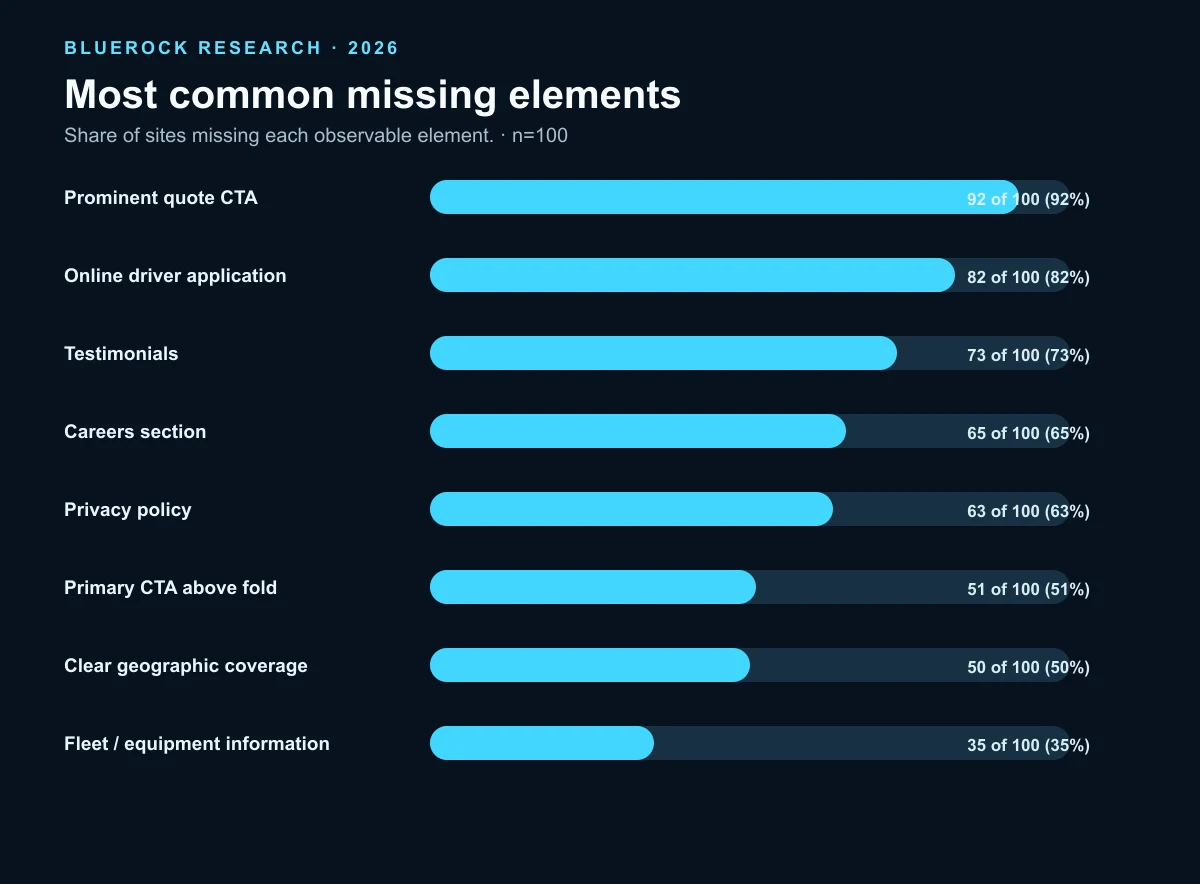
Finding 5: the most common omissions affect different audiences.
Quote actions affect prospective shippers, application paths affect drivers, while testimonials and privacy information affect public trust. The study did not measure whether any omission changed conversion or hiring outcomes.
What stronger sites did differently
Within this dataset, the more complete sites tended to separate shipper and recruiting actions, name specific services and coverage, expose a direct contact path, and present verifiable public proof. This is a pattern of co-occurring features, not evidence that one feature caused another business result.
- Put a specific quote, contact, or application action in the first mobile viewport.
- Explain freight types, equipment, and service coverage in concrete language.
- Separate shipper quote requests from driver applications.
- Use factual company history, associations, addresses, and testimonials where available.
- Publish a clear privacy policy and keep forms accessible on mobile.
Limitations
- • The deterministic sample is not a probability sample of every U.S. trucking company.
- • The frame covers eligible FMCSA carriers with a non-consumer corporate domain in the public contact record; companies using consumer email or omitting a corporate domain are not represented.
- • We evaluated public websites, not operations, safety, legal compliance, conversion rates, hiring outcomes, or revenue.
- • Websites and lab performance can change after the review date.
- • Some visual-image and performance-score fields remained unknown and are not presented as negative observations.
Research citation
BLUEROCK. “We Analyzed 100 Trucking Company Websites — Here's What We Found.” 2026.
- Published
- August 15, 2026
- Last updated
- August 15, 2026
- Author
- Maksym Belov / BLUEROCK
- Reviewer
- Maksym Belov
- Sample
- 100 websites
- Canonical URL
- https://www.bluerock.id/research/trucking-company-websites-study-2026
About BLUEROCK
Websites built around a trucking company's real operation.
BLUEROCK designs custom websites and digital systems for companies that need clearer positioning, stronger public proof, better mobile workflows, and measurable inquiry paths.
Planning a build? Read the trucking website cost and scope guide before defining the project.
See BLUEROCK trucking web design