Shippers
Explain modes, industries, coverage, communication, and what information starts a useful quote conversation.
Websites for transportation brokerages
Custom brokerage websites that explain what you coordinate, help people verify your business, and give shippers and carriers different paths forward.
One website · distinct pathways
The final labels and workflows are based on your real operation, systems, and compliance requirements.
Built for the brokerage model
A useful website recognizes that difference immediately instead of sending every visitor to the same contact form.
Explain modes, industries, coverage, communication, and what information starts a useful quote conversation.
Route capacity partners toward onboarding, load information, or the correct external portal without mixing them into sales inquiries.
Give candidates and business partners enough verified context to understand the brokerage before making contact.
Trust architecture
Professional design helps, but clarity and verifiable information do more of the trust work.
Present the legal business name, contact details, operating information, and relevant credentials accurately—without decorative trust badges.
Explain what the brokerage coordinates, who it serves, and how communication works without implying owned assets or capabilities it does not have.
Ask shippers for useful shipment details and direct carriers to a separate workflow with appropriate expectations.
Use real proof, customer permission, and documented facts. No invented load counts, network size, service areas, testimonials, or performance metrics.
Website scope
Services, modes, industries, and locations become dedicated pages only when the brokerage has real information worth publishing.
Pricing and integrations
A brochure site, a content-rich brokerage site, and a site connected to external operational tools are different projects. BLUEROCK confirms pages, content, forms, ownership, integrations, price, and timing before work begins.
Request a Project Review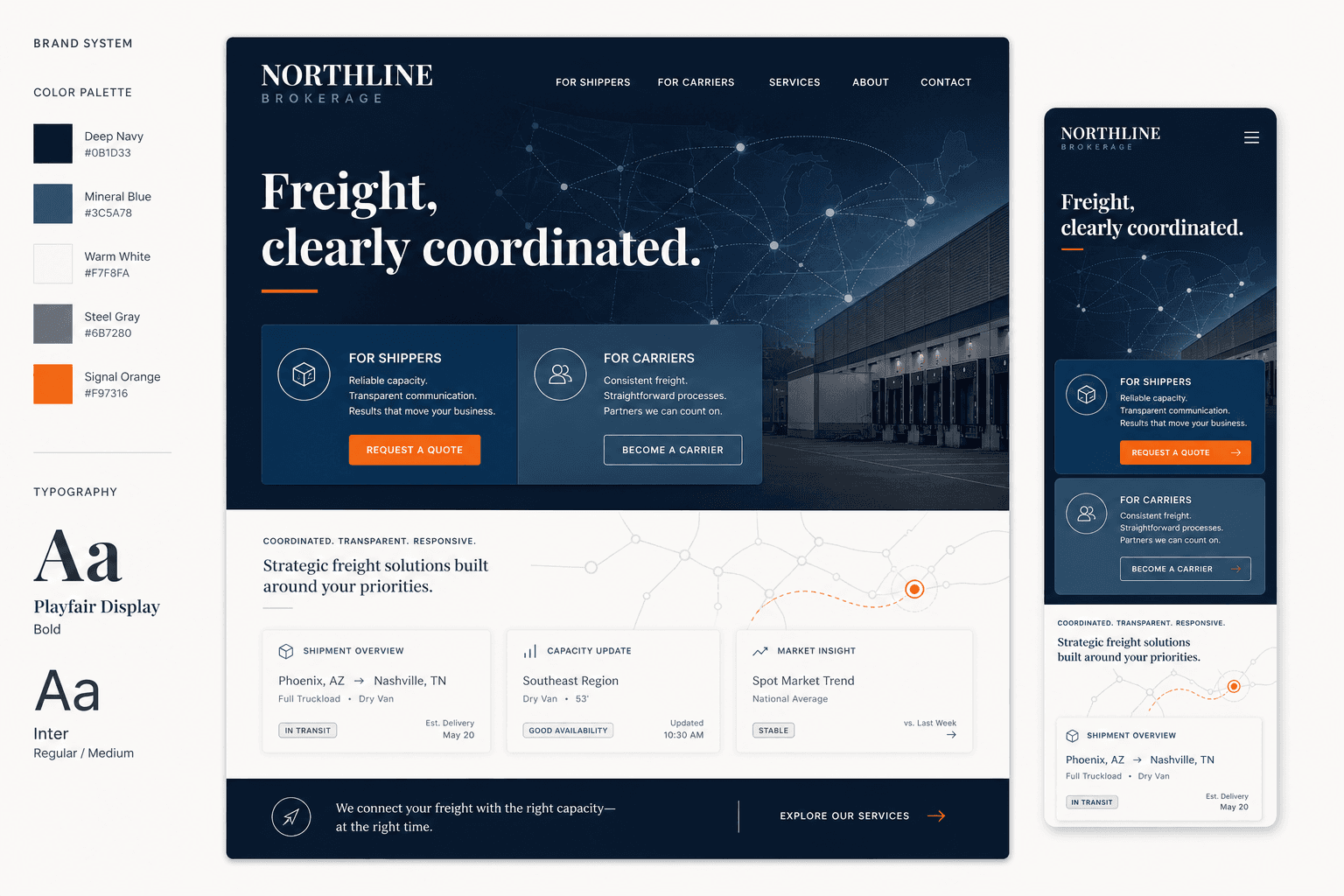
Original concept study
A visual and structural exploration that separates shipper and carrier decisions while presenting a brokerage as coordinated, legible, and modern.
FAQ
A useful brokerage website normally needs clear positioning, services or modes, industries or shipment types when relevant, coverage information, verified company and contact details, separate shipper and carrier paths, and focused inquiry forms. The exact structure should reflect the real brokerage rather than a generic logistics template.
A broker coordinates capacity between shippers and carriers, while a motor carrier operates under a different business model. The website should describe that role precisely, avoid implying an owned fleet when there is none, and create distinct paths for shippers and carrier partners.
Potentially, yes. BLUEROCK first reviews the real workflow, vendor documentation, access requirements, data handling, and ownership of each step. We do not promise an integration until its technical and operational requirements are confirmed.
The website can make verified information easier to evaluate through clear identity, services, operating details, contact information, proof, and professional presentation. It cannot replace due diligence, authority checks, contracts, insurance verification, or the quality of the brokerage's actual operation.
No. The site can be built with crawlable pages, page-specific metadata, internal links, structured data, analytics, and conversion paths, but rankings and lead volume depend on competition, demand, authority, content quality, and the real offer. We measure what happens after launch and improve from evidence.
Operating trucks instead?
Tell us how your brokerage operates, who it serves, and what should happen after each audience visits.
Start Your Website