Design inspiration with a purpose
Trucking Website Examples and Design Lessons
A useful trucking website is more than a good-looking hero image. Use examples to study how a site explains the operation, supports trust, and routes each visitor toward the right action.
For a data-based benchmark, read BLUEROCK's analysis of 100 trucking company websites.
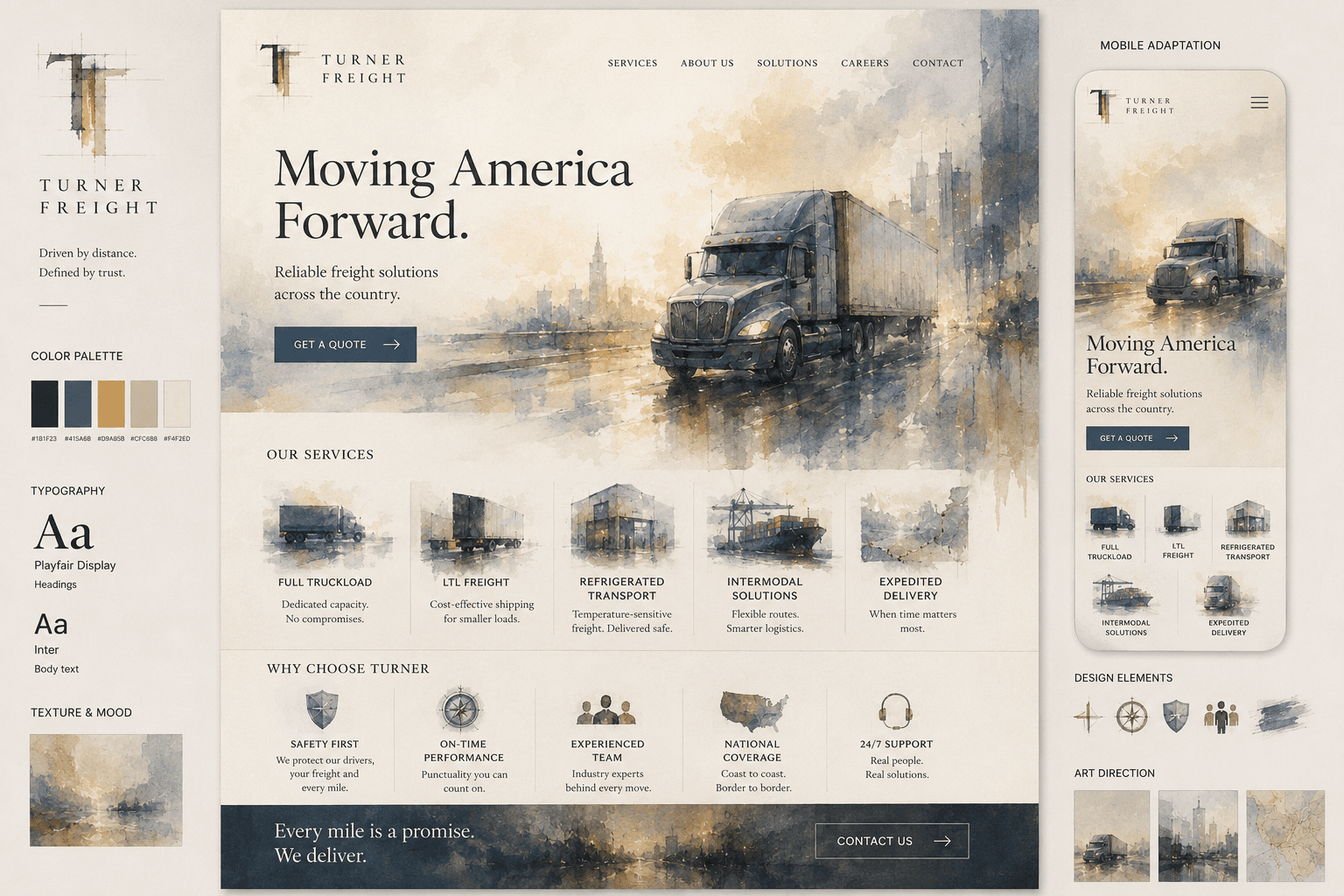
Original example · Turner Freight
Distinctive does not have to mean unclear.
The concept uses an atmospheric editorial direction instead of a generic highway photograph. Its proposed production structure would still need immediate service clarity, verified equipment and coverage, separate quote and recruiting paths, and the carrier's real content.
Transparency: Turner Freight is a fictional design study, not a client case and not evidence of measured performance.
View the Full Concept StudySeven design lessons
What to look for beyond appearance.
State the business model immediately
A visitor should understand whether the company is a motor carrier, owner-operator, freight broker, 3PL, or another transportation business. Generic logistics language creates uncertainty.
Explain real services and equipment
Name the freight types, equipment, and capabilities the company actually offers. Do not copy a competitor's service list or imply unavailable capacity.
Make coverage useful
Describe real service areas, lanes, terminals, or operating regions at the level the company can support. A decorative map without context does not answer a shipper's question.
Use proof people can verify
Company history, authority information, insurance context, certifications, equipment, customers, testimonials, and metrics should appear only when accurate, current, and approved.
Separate recruiting from sales
Drivers and owner-operators need different information and forms than shippers. A single contact page should not carry every workflow.
Ask for the right next step
Quote forms should collect enough freight context to route an inquiry without demanding unnecessary sensitive information. Calls, email, applications, and portals need clear ownership.
Design for people on the road
Navigation, forms, phone links, job information, and service details must remain usable on a small screen and a variable mobile connection.
A practical review
Seven questions for any example you save.
If an inspiring site cannot answer these questions, borrow the visual idea carefully—not the business structure.
- 1Can I tell what this company does from the first screen?
- 2Can I confirm services, equipment, and coverage without guessing?
- 3Can a shipper, driver, and partner find different next steps?
- 4Are the visible claims specific, current, and verifiable?
- 5Does the mobile version preserve the important content and actions?
- 6Is the contact or quote flow asking for useful information?
- 7Does the visual identity belong to this company rather than the industry in general?
FAQ
Using trucking website examples
What makes a good trucking company website?
A good carrier website explains the real operation clearly, shows relevant services and coverage, presents verifiable trust information, separates shipper and recruiting paths, works well on mobile, and gives each visitor an appropriate next step.
Should a trucking website show the fleet?
Show equipment when the information is accurate and useful to the intended audience. Original photography and specific equipment details can be valuable, but the website should not imply fleet size, ownership, condition, or capabilities that cannot be supported.
Can I copy sections from a trucking website I like?
Use other sites to identify useful patterns, not to copy branding, writing, images, claims, or structure wholesale. The final content should reflect your own operation, audiences, proof, and workflows.
Is Turner Freight a real BLUEROCK client?
No. Turner Freight is a fictional brand and original design study created by BLUEROCK. It demonstrates a possible visual and structural direction and makes no claims about client work or measured results.
Turn inspiration into a website for your operation.
BLUEROCK can explore distinct visual directions, then build the chosen direction around your real services, equipment, coverage, proof, and workflows.