Residential locksmith paths
Route lockouts, rekeying, repair, replacement, installation, move-in changes, mailbox or cabinet work, smart locks, key work, and scheduled security reviews only where actually supported.
Urgent fit · verified identity · safe intake
Help a locked-out customer or facility buyer verify the business, confirm service fit, share only safe minimum details, and understand the next step without confusing a call or form with a technician, dispatch, access, final price, or completed work.
Start Your WebsiteFirst-screen routing
Route lockouts, rekeying, repair, replacement, installation, move-in changes, mailbox or cabinet work, smart locks, key work, and scheduled security reviews only where actually supported.
Capture vehicle year, make, model, location and observed need at a safe minimum; separate lockout, lost key, duplication, programming, ignition, trunk and specialty capability without promising universal vehicle coverage.
Give property managers, facilities teams, landlords, contractors and authorized representatives paths for doors, hardware, rekeying, master-key or restricted systems, access control, safes and recurring service according to real qualifications and product capability.
Use a protected review path for supported safe, vault, high-security, restricted-key, electronic access and specialty work. Do not request combinations, credentials, detailed vulnerabilities or bypass information through a public form.
Show the exact legal or public business identity, real phone and domain, approved address or service-area model, current licenses where required, insurance, registrations, memberships, technicians and credentials only when verified and correctly scoped.
Separate phone answering, intake, live review, dispatch, arrival, emergency call-out, scheduled work, staffed hours, after-hours, territory, travel, vehicle/product fit, technician capability, workload, weather and unavailable states.
Use approved project evidence with service type, product or system only when safe, business role, actual scope and status. Remove addresses, key details, codes, credentials, schedules, occupant patterns, vulnerabilities and other access-sensitive information.
Explain verified service-call, labor, parts, diagnostic, after-hours, travel, programming, hardware, tax and payment practices. Do not invent low teaser prices, final totals before inspection, insurance coverage, arrival time or a guaranteed non-destructive method.
The customer selects the supported job type and shares minimum location, role, authority, observations, safety context, fit information and contact details.
The company checks territory, staffed availability, technician and product/vehicle capability, exclusions, safe handling, identity or authorization requirements, access constraints and information gaps.
Applicable call-out, labor, diagnostic, travel, after-hours and known product information is explained; dispatch, appointment and any preliminary estimate are separately confirmed.
The technician verifies identity, authority, property or vehicle, actual condition, safe access and job fit before diagnosing options or beginning access-sensitive work.
Method, limitations, price or approved basis, parts, risk, alternatives and scope are authorized before supported entry, repair, rekeying, installation, cutting, programming or other work.
Function, keys or credentials delivered, customer acceptance, documentation, payment, care, warranty and follow-up reflect actual work. The website does not manufacture access, a successful repair or a security guarantee.
Most need a focused homepage, urgent and scheduled contact paths, exact residential, automotive, commercial and specialty services actually offered, truthful coverage and hours, verifiable business identity, current credentials where applicable, safe project evidence, pricing practices, process, FAQs and contact details.
Only when the company genuinely staffs and can honor that exact claim. Phone answering, intake, live review, dispatch, arrival, territory, technician fit and emergency service are different. Closed, unavailable, unsupported and out-of-area states should remain honest.
Not in an ordinary public form. Collect only the minimum needed to qualify the request. Identity, possession and authority can be verified through the company’s secure process and again before access-sensitive work. Do not request key photographs, codes, combinations or unnecessary personal documents.
Only with a precise, supportable explanation of what it includes and excludes. Job condition, service call, labor, diagnosis, time, location, vehicle or product fit, parts, programming, hardware, tax and authorization can change the total. Avoid bait pricing and unsupported final estimates.
No. It can improve mobile access, technical quality, local relevance, identity verification, service clarity and request fit. Competition, proximity, business-profile eligibility, reputation, licenses, spam in the market, availability, pricing, promotion and follow-up also affect results.
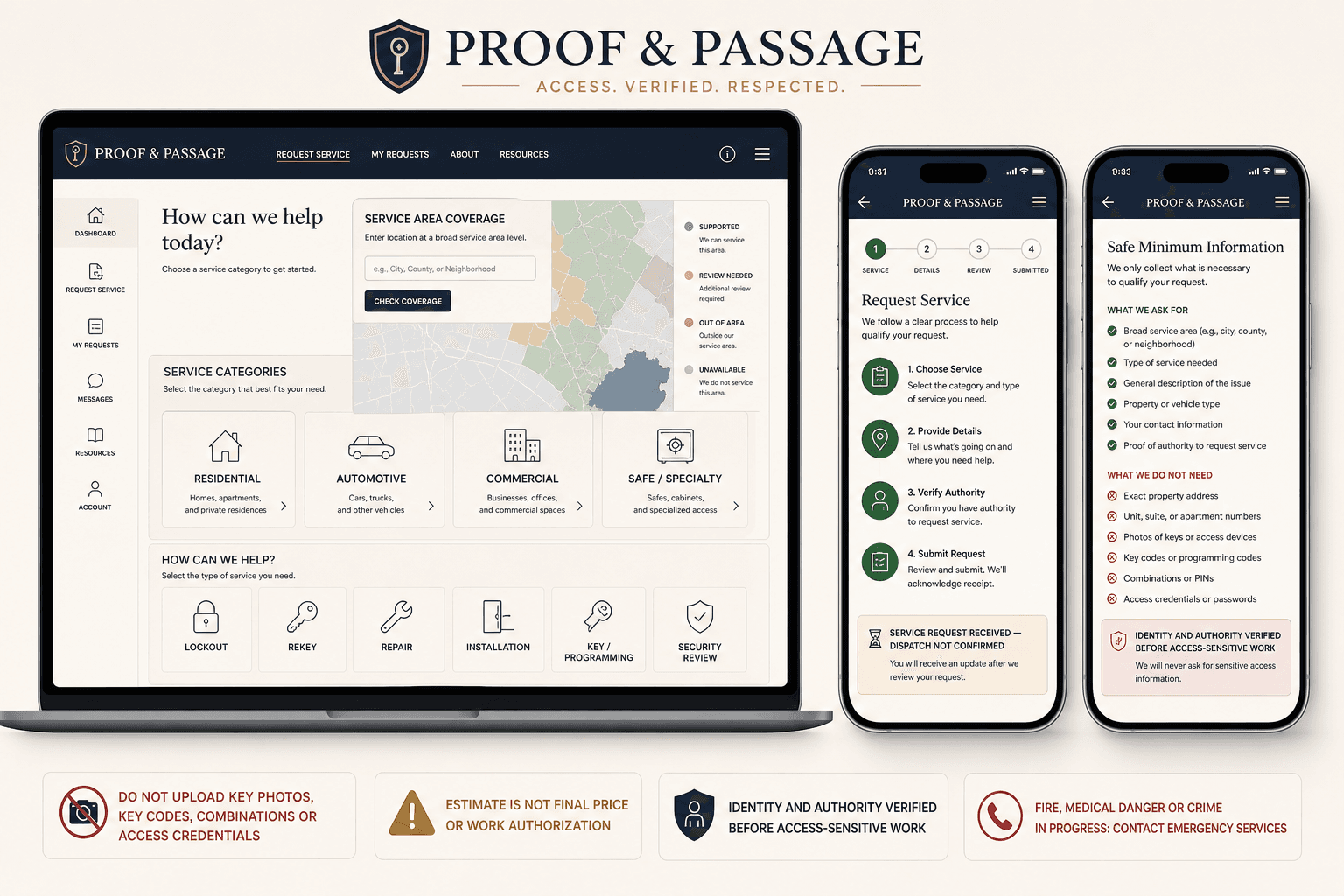
Original concept · Fictional brand
Proof & Passage shows how broad coverage, service fit, customer authority, sensitive-data boundaries, estimate status, dispatch, and work authorization can remain understandable during both urgent and scheduled requests.
View Proof & Passage Concept