Urgent service
Show the verified phone number, actual hours, coverage, eligible work, and what after-hours contact means. Do not label the company 24/7 unless that is accurate.
Urgent contact · scheduled service · verified trust
Help the right customer confirm service and location fit, understand what happens next, and reach the company through a path the dispatch or sales workflow can actually support.
First-screen clarity
Request architecture
Show the verified phone number, actual hours, coverage, eligible work, and what after-hours contact means. Do not label the company 24/7 unless that is accurate.
Route repair, maintenance, estimate, consultation, indoor-air-quality, and other real services into the company’s approved scheduling or request process.
Collect property, system, timing, comfort, and contact context for review without promising equipment, price, rebates, savings, financing, or installation dates.
Ask for facility type, location, system or scope context, urgency, access, timing, and the appropriate property or operations contact.
Trust and local fit
Publish licenses, certifications, insurance or bonding context, memberships, awards, and years only from current approved records.
Use genuine coverage and operating limits. A useful location page needs distinct service information and proof—not a city name inserted into repeated copy.
Use authentic reviews, original team and work images, documented guarantees, and client-approved cases. Never manufacture ratings, names, or before-and-after work.
Explain approved pricing context, diagnostic fees, estimates, maintenance plans, financing providers, eligibility, rebates, and promotions without guaranteeing approval or savings.
Operational integrations
Define the provider, form fields, routing, customer matching, duplicate behavior, status, errors, privacy, ownership, and fallback when the integration is unavailable.
Offer real slots only when availability, service duration, technician or territory rules, confirmation, cancellation, and operational capacity are synchronized.
Use approved numbers, routing, recording and consent practices, attribution, business-hours behavior, failure handling, and ownership. Tracking must not break the primary contact path.
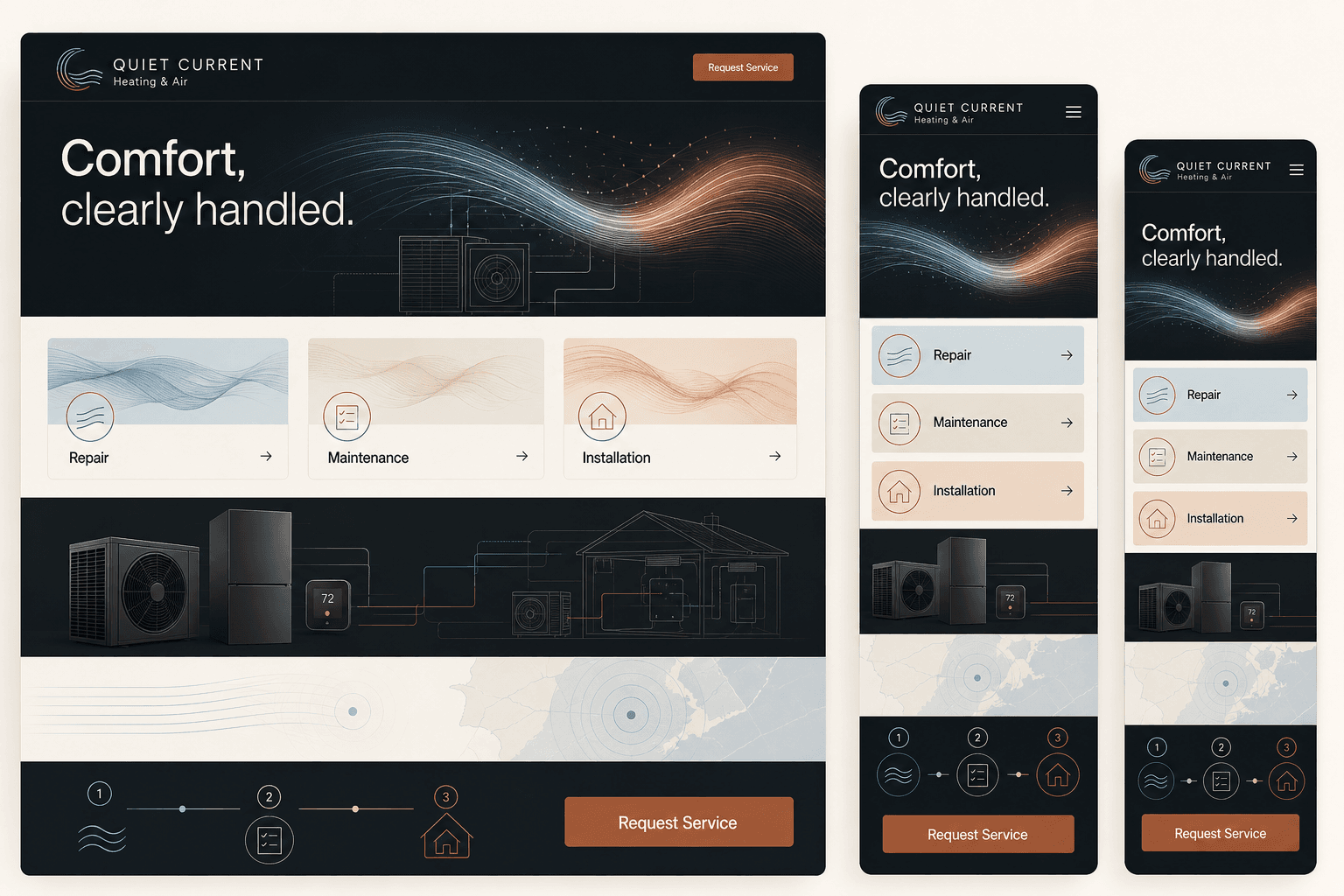
Original design study
Quiet Current uses calm technical visuals and separate repair, maintenance, and installation paths. It is clearly labeled as fictional and makes no operational claims for a real company.
Explore the full conceptFAQ
Most HVAC sites need a focused homepage, distinct service pages, accurate service-area information, about or trust content, maintenance or financing information when real, reviews or project proof, and clear urgent and scheduled contact paths. Commercial, careers, locations, rebates, resources, and equipment pages should be added only when supported.
A separate page is useful when the service is genuinely offered and has distinct customer needs, scope, proof, questions, or search intent. Do not create dozens of nearly identical service-and-city combinations solely to increase page count.
A connection may be possible depending on the provider, account, available APIs or widgets, permissions, fields, workflow, privacy, support, and scope. BLUEROCK does not represent a marketing form as a working operational integration until it is configured and tested end to end.
Only when the company confirms the exact service, hours, coverage, response process, exclusions, and contact handling. The website should not imply immediate dispatch, guaranteed arrival time, or continuous availability without operational support.
No. A website can improve clarity, technical access, local relevance, mobile contact, service content, proof, and inquiry routing. Competition, proximity, reputation, demand, seasonality, authority, availability, pricing, promotion, and follow-up also affect results.
Bring the verified services, areas, hours, credentials, maintenance and financing details, contact paths, and operational systems.
Start Your Website