BLUEROCK Research · Flagship Study #2
We Analyzed 100 Accounting and Bookkeeping Websites — Here's What We Found
BLUEROCK reviewed 100 public U.S. accounting, bookkeeping, and business-tax websites on August 17, 2026, using a locked IRS-based sampling method and a consistent 20-field codebook. Only 30 of 100 sites presented an explicit consultation CTA, 29 showed a clearly labelled client portal, and 13 published testimonial content. At the same time, 70 offered a prospect inquiry form and 91 made some contact action readily accessible. The study measures observable website structure—not professional competence, credential validity, security, or business performance.
Key findings
Contact was usually possible. A clearly designed prospect journey was much less common.
70 of 100 (70%)
did not present an explicit consultation, scheduling, booking, or get-started CTA in the initial path.
87 of 100 (87%)
did not publish testimonial or client-review content on the inspected public site.
71 of 100 (71%)
did not show a clearly labelled client-portal or existing-client login link.
62 of 100 (62%)
did not provide a clickable phone action on the homepage.
70 of 100 (70%)
provided a public prospect-oriented inquiry form.
91 of 100 (91%)
made a contact action accessible from the homepage or header path.
Methodology
The frame, eligibility rules, ranking seed, evidence rules, and codebook were fixed before aggregate findings were calculated.
Sampling frame. We froze the IRS Authorized IRS e-file Provider FOIA master extract dated June 22, 2026; filtered U.S. business records with a DBA name, business-return filing indicators, and at least 10 transmitted returns; then ranked 151,285 eligible records using SHA-256 and a recorded seed.
Website eligibility. Candidates were reviewed in rank order. A site had to be a unique, reachable official business website clearly offering accounting, bookkeeping, or business-tax services. Directories, social profiles, parked domains, duplicates, and ambiguous matches were excluded.
Collection. Twenty fields were coded from homepages and matched public pages. Every field stores a value, evidence note, inspected URL, and timestamp. Mobile checks used local Chrome at 390×844.
Privacy. The public CSV excludes names, domains, IRS identifiers, addresses, phone numbers, copied text, and personal data.
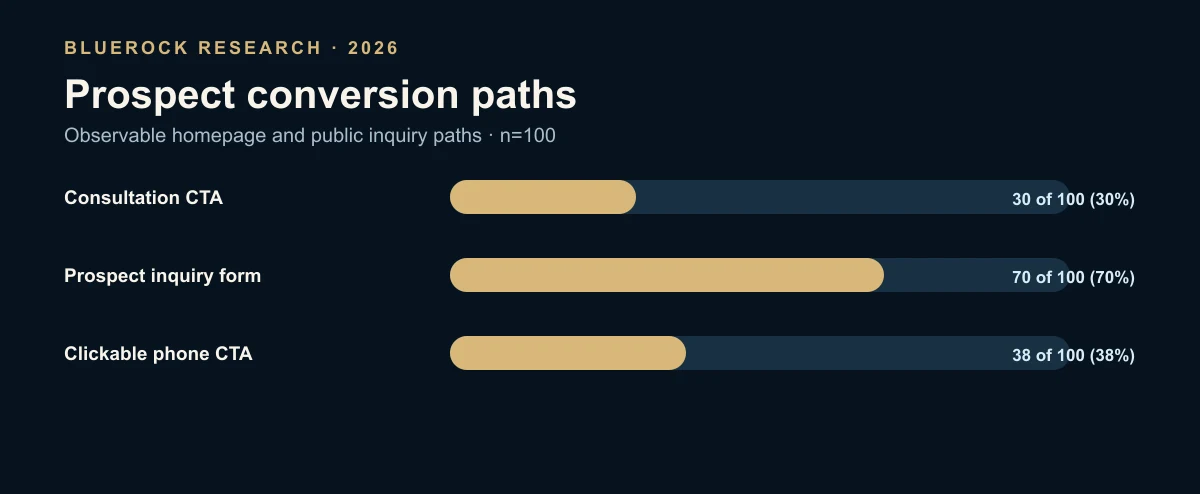
Finding 1: forms and consultation positioning were not the same thing.
A prospect form appeared on 70 of 100 (70%) sites, but an explicit consultation CTA appeared on only 30 of 100 (30%). Among the 30 sites with that CTA, 26 also had a prospect form; 44 additional sites had a form without positioning consultation as an initial action.
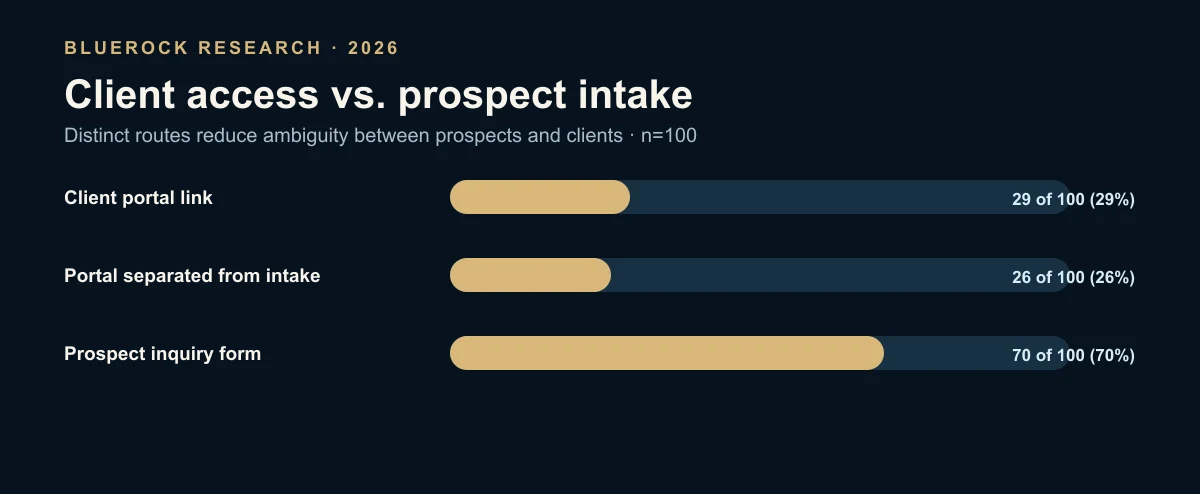
Finding 2: portals rarely defined the complete visitor journey.
A labelled client portal appeared on 29 of 100 (29%) sites. Distinct portal and prospect-intake paths appeared on 26 of 100 (26%). This measures public navigation, not portal quality or security.
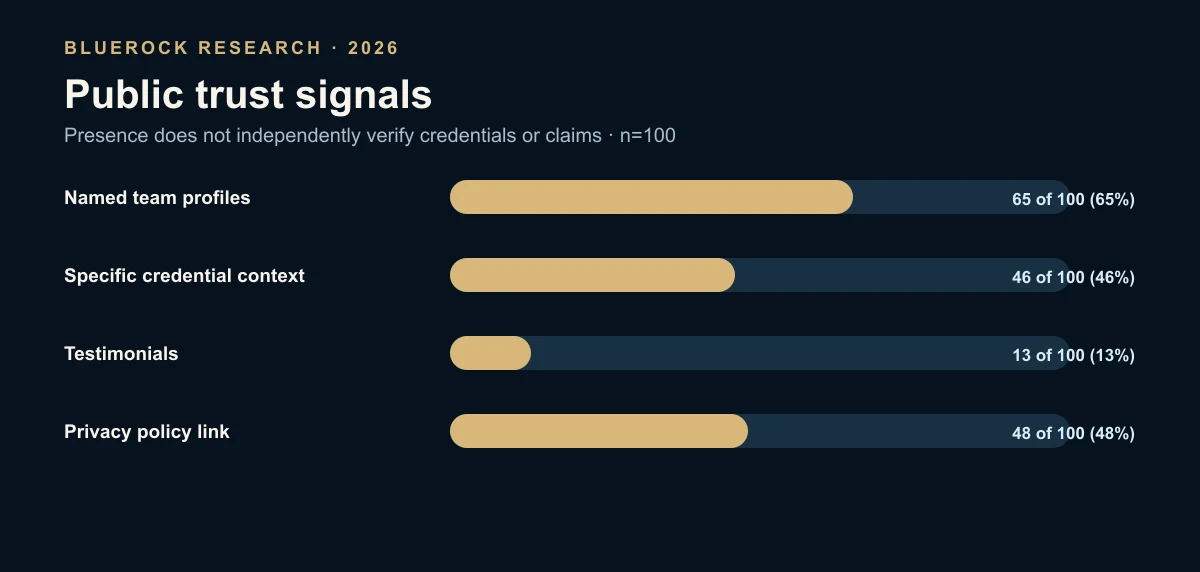
Finding 3: public proof was uneven.
Named team context appeared on 65 of 100 (65%) sites, specific credential-category language on 46 of 100 (46%), testimonials on 13 of 100 (13%), and a privacy link on 48 of 100 (48%). Credential and security claims were not independently verified.
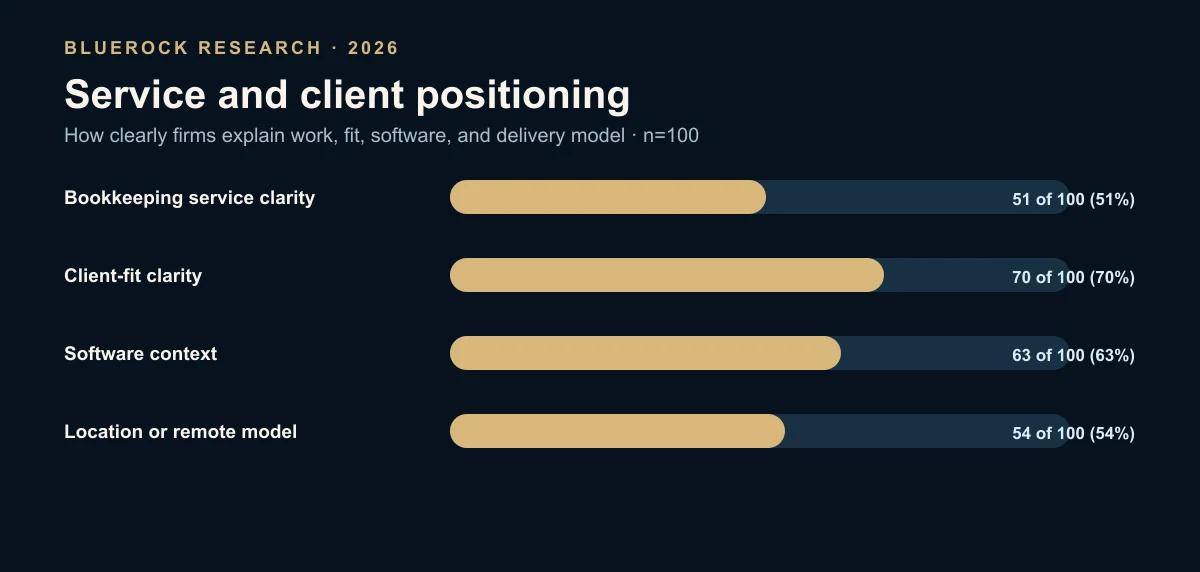
Finding 4: firms explained client fit more often than bookkeeping detail.
Client-fit context appeared on 70 of 100 (70%) sites, while concrete bookkeeping-service detail appeared on 51 of 100 (51%). Software or workflow context appeared on 63 of 100 (63%).
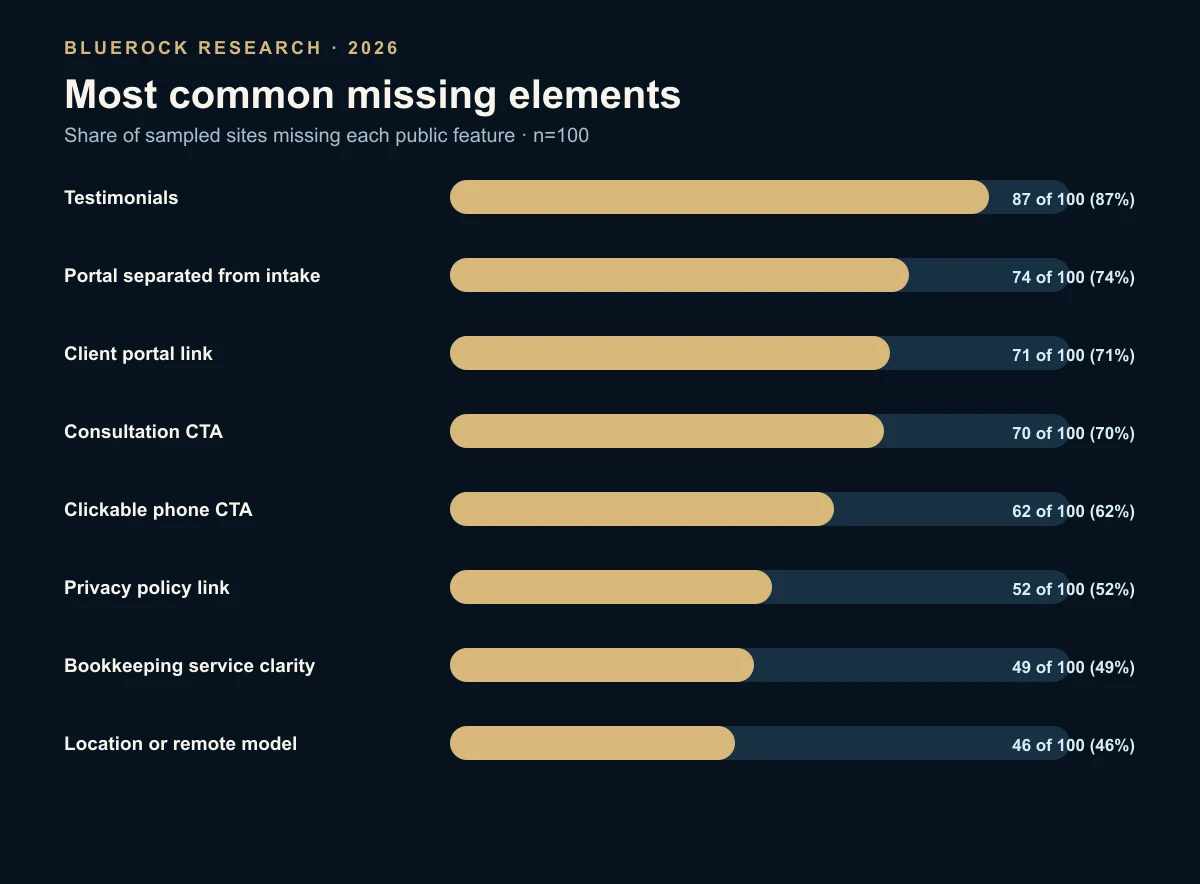
Finding 5: the most frequent gaps affect trust and next-step clarity.
The most common omissions were testimonials, distinct portal-versus-intake paths, labelled portal links, explicit consultation CTAs, clickable phone actions, and privacy links. The study did not measure whether any omission changed conversions or client outcomes.
What more complete sites did differently
The more complete public experiences separated prospects from existing clients, explained concrete services and client fit, and made trust evidence easy to inspect. These are co-occurring website patterns, not proof of causation.
- Use one explicit consultation or get-started action in the first mobile path.
- Keep prospect intake visually separate from secure existing-client access.
- Explain recurring bookkeeping work and suitable client types in concrete language.
- Name real team members and credential categories without vague or unverifiable claims.
- Publish a privacy notice and avoid requesting sensitive documents through a generic contact form.
Limitations
- • This is a deterministic website-bearing sample, not a probability sample of every U.S. firm.
- • The IRS e-file-provider frame does not include every bookkeeping-only practice.
- • We evaluated public websites—not competence, credential validity, security, compliance, conversion, revenue, or client satisfaction.
- • Credential and security language was coded for visible context only and was not independently certified.
- • Websites can change after August 17, 2026.
Research citation
BLUEROCK. “We Analyzed 100 Accounting and Bookkeeping Websites — Here's What We Found.” 2026.
- Published
- August 17, 2026
- Author
- Maksym Belov / BLUEROCK
- Sample
- 100 websites
- Canonical URL
- https://www.bluerock.id/research/accounting-firm-websites-study-2026
About BLUEROCK
Accounting websites designed around trust, fit, and a clear next step.
BLUEROCK builds custom websites and digital systems for accounting firms that need clearer positioning, stronger public proof, and better prospect workflows.
Planning a build? Read the accounting website cost and scope guide before defining the project.
See accounting firm web design