Business owners
Help a prospect identify whether the firm serves their business type, stage, location, accounting needs, and preferred working relationship.
Websites for accountants, CPAs, and tax professionals
A clear, credible website that helps the right prospective clients understand who you serve, what the firm actually provides, and how to start an appropriate conversation.
Fit before contact
A useful accounting website helps visitors self-select before the consultation, without overstating expertise or turning every service into a vague promise.
Help a prospect identify whether the firm serves their business type, stage, location, accounting needs, and preferred working relationship.
Separate personal tax or planning services when offered, with accurate eligibility, timing, and consultation expectations.
Present nonprofit, real estate, professional-service, multi-entity, or other niche experience only when the firm genuinely provides it.
Original concept study
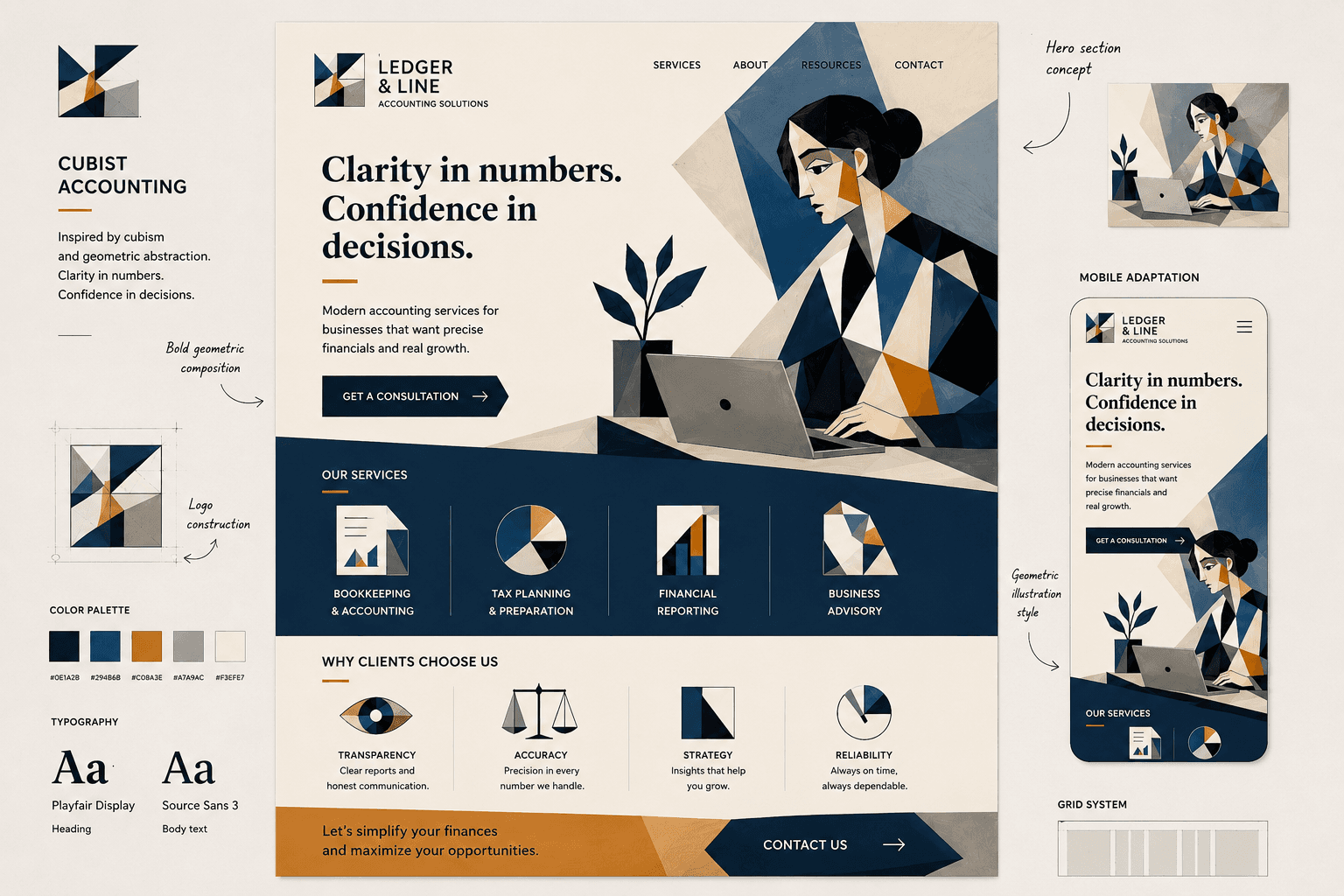
A cubist-inspired direction showing how an accounting brand can communicate precision and confidence without defaulting to stock handshakes, calculators, or generic corporate blue.
Accounting & bookkeeping guides
See the evidence behind these priorities in our 2026 study of 100 accounting and bookkeeping websites. For budget planning, compare the accounting website cost guide with our current website starting scope.
Trust architecture
Use real names, roles, biographies, licenses, certifications, and professional affiliations only after the firm confirms how they should be presented.
Replace broad 'financial solutions' language with an understandable service structure, audience fit, boundaries, and next step.
Publish reviews, client logos, outcomes, pricing, years, industries, and claims only with permission and evidence appropriate to the context.
Keep general inquiries separate from document exchange, account access, tax data, and client portals. Connect approved secure systems rather than recreating them casually.
Website scope
A public form should collect only the information needed to route an initial conversation. Sensitive documents, tax identifiers, account data, and existing-client work belong in a separately approved secure system.
BLUEROCK can design the handoff and connect approved tools after reviewing their documentation. We do not represent a standard contact form as secure document exchange.
FAQ
Most firms need a focused homepage, service pages, information about the people and firm, the clients or industries they are best equipped to serve, locations or service area when relevant, and a clear consultation or contact path. Resources, pricing, careers, and client portals should appear only when they support the real practice.
Potentially, yes. BLUEROCK reviews the approved vendor, link or integration method, authentication boundaries, data flow, branding options, analytics, and support ownership before defining the implementation.
A general website form should not casually request sensitive tax, identity, account, or financial documents. Document exchange should use a deliberately selected and approved secure workflow with clear ownership and access controls.
Yes, when those are real services with enough distinct information to help a visitor make a decision. Separate pages should not be created simply to repeat the same generic text under different keywords.
No. The website can improve clarity, discovery, trust presentation, measurement, and consultation flow, but results also depend on demand, competition, location, reputation, the firm's offer, search authority, and follow-up.
Tax-focused practice
Clarify who the practice serves, whether new clients are being accepted, how appointments work, and where documents belong.
Tell BLUEROCK which services matter, who the firm is best equipped to serve, what must be verified, and how a prospective client should begin.
Start Your Website