Residential exterior cleaning
Route siding, masonry, stucco, roofs, gutters, fences, decks, patios, windows, screens, solar panels, and other genuinely supported work by material, condition, height, access, and objective.
Surface · condition · access · verified proof
Show real transformations by surface, qualify property and access context, and prepare a useful estimate without promising that every stain, material, or job has the same solution.
Start Your WebsiteFirst-screen routing
Route siding, masonry, stucco, roofs, gutters, fences, decks, patios, windows, screens, solar panels, and other genuinely supported work by material, condition, height, access, and objective.
Qualify driveways, sidewalks, curbs, pool decks, loading areas, parking structures, pavers, stone, and other flatwork by surface, coating, staining, drainage, traffic, and surrounding property.
Give property managers, associations, retail, restaurants, facilities, fleets, and recurring accounts a path for scope, sites, operating hours, access, documentation, and vendor requirements.
Explain pressure, soft-wash, hot-water, chemical, restoration, sealing, or specialty processes only when the company actually supports them and can state material and safety limits accurately.
Use approved pairs from the same real project, angle, surface, and scope. Identify the company’s role and do not alter images in ways that misrepresent the result.
Publish current insurance, licenses, certifications, training, safety programs, equipment, reviews, awards, years, commercial requirements, and manufacturer relationships only from approved records.
State genuine service areas, supported property and surface types, travel, minimums, water or access needs, season, weather limits, operating hours, and scheduling capacity.
A website request cannot establish the correct process, chemical, pressure, restoration potential, runoff controls, permissions, final price, schedule, or suitability for every surface.
The customer provides property, surface, condition, dimensions, access, surroundings, photos, location, timing, and contact context.
The company checks service and territory fit, material, condition, access, water, drainage, capacity, information gaps, and the supported next step.
A call, additional evidence, test area, site visit, or specialist input resolves what cannot be established from the form.
Scope, method, assumptions, exclusions, protection, runoff handling, price basis, schedule, and terms are documented accurately.
The customer or appropriate decision-maker approves the supported work and access; the company confirms the appointment or project separately.
Preparation, protection, work, changes, cleanup, project evidence, payment, care guidance, and follow-up match actual operations.
Original design study
Surface & Flow is a fictional BLUEROCK concept. It organizes site-review context without turning customer observations, images, or a form submission into a selected method, confirmed estimate, or appointment.
View the Surface & Flow Concept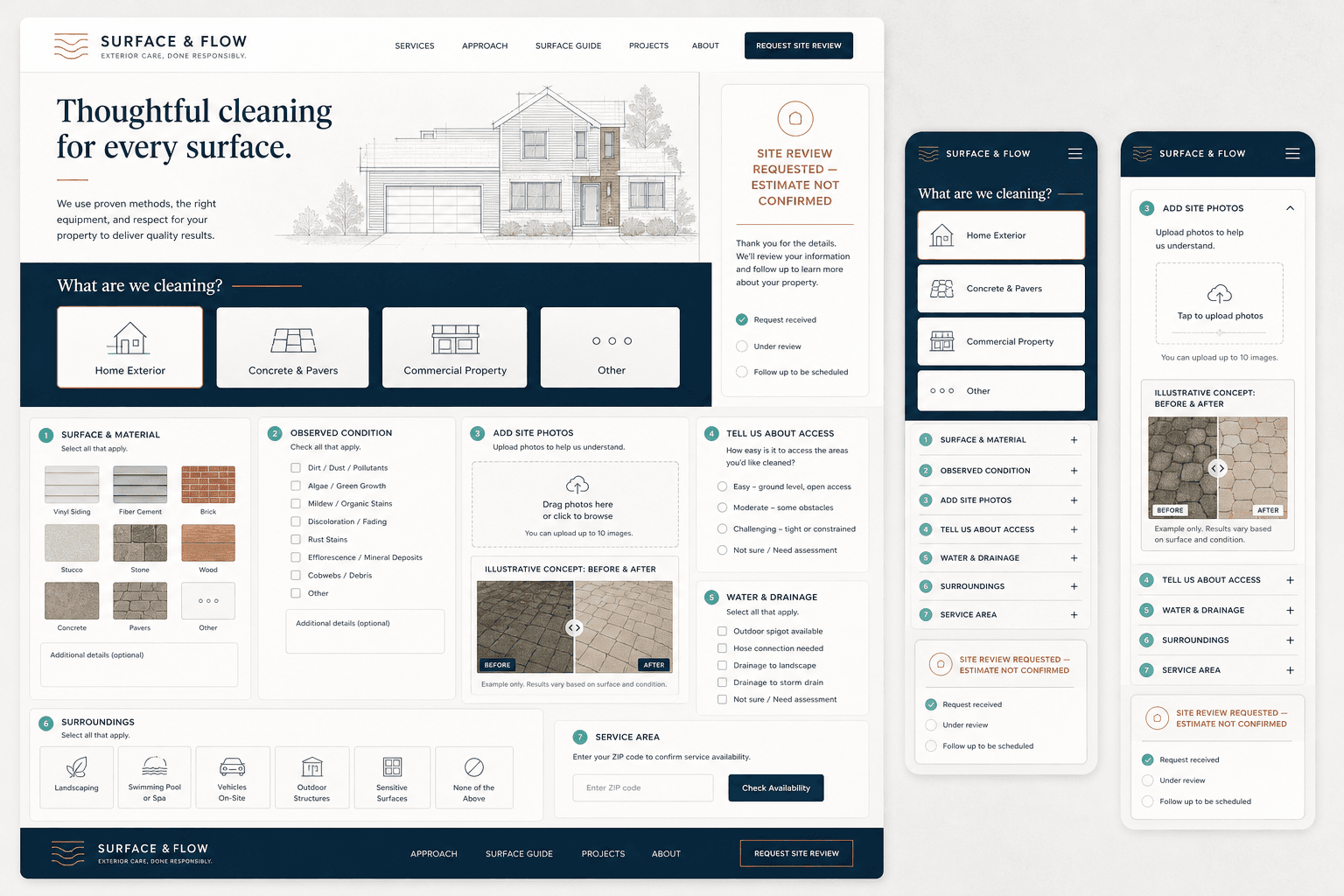
Most companies need a focused homepage, real service and surface pages, truthful service-area information, approved before-and-after projects, process and company content, an estimate request, and contact details. Roof, soft wash, commercial, fleet, restoration, sealing, recurring, or location pages should exist only when supported.
Pair images from the same real job and comparable viewpoint, identify the surface and actual scope, obtain permission, preserve accurate color and condition, and explain meaningful constraints. Stock photos, AI concepts, unrelated jobs, or heavily altered images should not be presented as completed work.
Only when the company has a tested and approved pricing model for the supplied inputs. Surface, dimensions, condition, height, access, water, treatment, protection, runoff, minimums, travel, and specialty work may require review. Any preliminary estimate should be labeled clearly.
They can when the company genuinely offers both and can explain supported surfaces, methods, limitations, and customer intent without oversimplifying technical decisions. The finished site should not instruct a customer to select an unsafe process for an unknown material.
No. It can improve technical access, service clarity, local relevance, mobile contact, project proof, and request quality. Competition, proximity, reputation, season, weather, capacity, pricing, advertising, and follow-up also affect results.