Route by event and service
Water, fire/smoke/soot, storm, contents, mitigation, reconstruction, commercial, environmental, and specialty requests start in distinct paths supported by the real company.
Fictional concept · Design study
An original responsive intake direction that makes event type, reported affected areas, source/status, safety concerns, utilities, occupants, records, insurance boundaries, and next states legible during a stressful request.
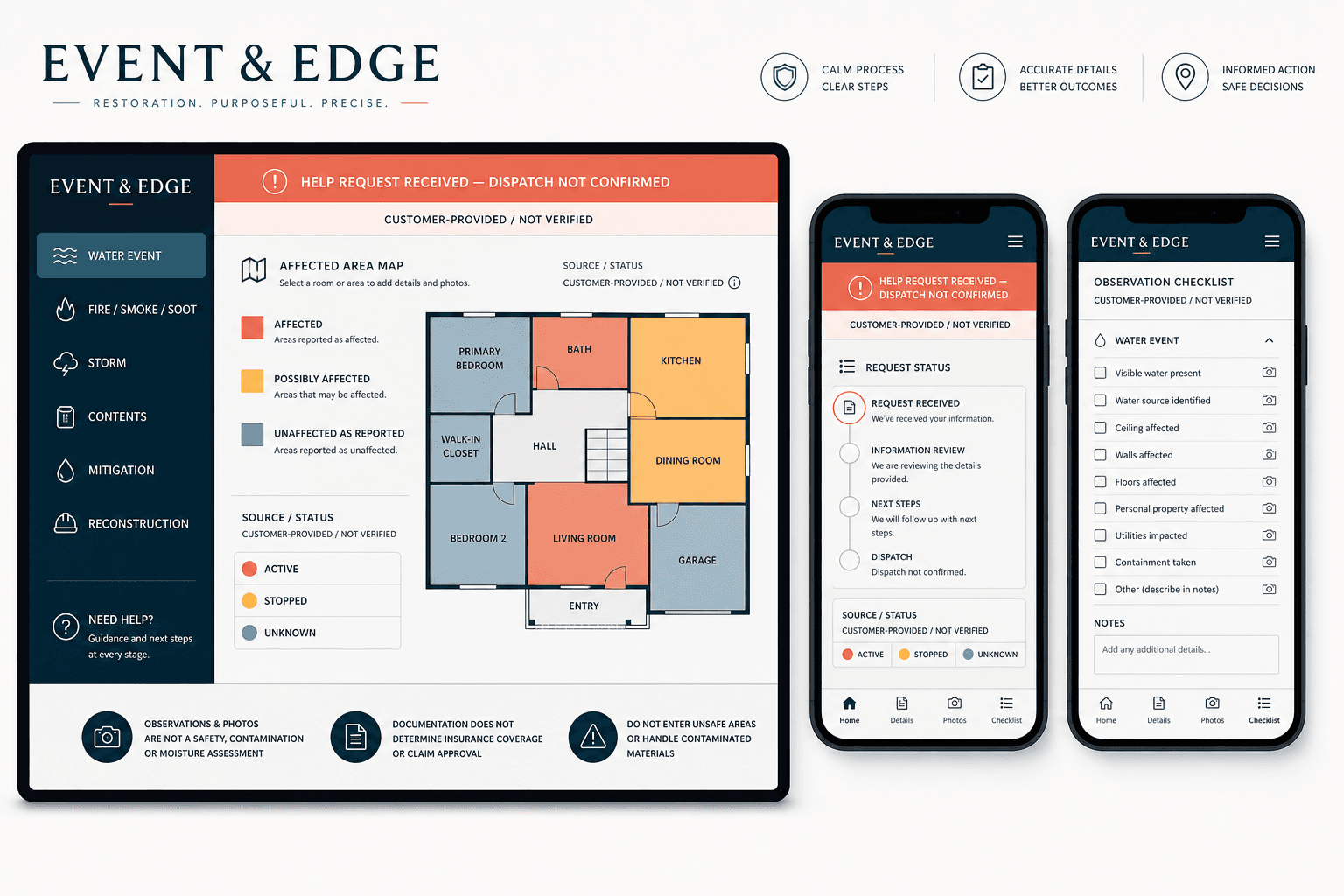
Event & Edge is a fictional brand created by BLUEROCK. This is not client work. The company, customer, property, event, affected areas, source/status, observations, photos, documents, occupants, utilities, contacts, damage, service paths, and workflow states are illustrative. Nothing shown establishes source, cause, category, class, moisture extent, contamination, microbial condition, air quality, structural/electrical safety, entry or occupancy safety, measurements, salvageability, coverage, claim approval, estimate acceptance, payment, dispatch, arrival, emergency response, stabilization, service availability, testing, clearance, reconstruction authorization, license, certification, completed work, warranty, guarantee, or outcome.
Design question
The concept captures useful customer observations and operational context while reserving field findings, professional decisions, insurer decisions, authorization, and work for the responsible parties.
Water, fire/smoke/soot, storm, contents, mitigation, reconstruction, commercial, environmental, and specialty requests start in distinct paths supported by the real company.
Rooms and levels can be marked affected, possibly affected, or unaffected as reported. The map prepares review without establishing source, category, class, moisture extent, contamination, safety, or scope.
Active, stopped, or unknown remains customer-provided and unverified. Request received, review, dispatch confirmation, and arrival are separate states.
Known emergency contacts, power, gas, water, alarms, access, occupants, pets, tenants, employees, and public exposure guide follow-up without asking anyone to enter or handle unsafe areas.
Photos, video, sketches, inventories, reports, estimates, and authority or utility records support review but do not become diagnosis, testing, clearance, coverage, approval, or authorization.
The interface can organize claim identifiers and communication securely when needed while making clear that an insurer decides coverage, acceptance, payment, and claim approval.
Interaction architecture
Select the supported event, specialty, commercial, contents, mitigation, reconstruction, service, or warranty path.
Record areas and source/status as customer-provided observations, plus timing, prior actions, photos, and what is unknown.
Share emergency, utility, building, occupant, access, safety-concern, and contact status without self-assessing entry, contamination, structure, electricity, or air.
Provide approved photos, inventories, reports, estimates, identifiers, authority or utility records, invoices, leases, consent, and contact information with appropriate privacy controls.
Confirm receipt without manufacturing dispatch, arrival, availability, emergency stabilization, diagnosis, testing, coverage, price, or authorization.
The actual company separately reviews, confirms dispatch or another next action, assesses, stabilizes, documents, mitigates, scopes, coordinates decisions, reconstructs, completes required testing or clearance, and closes out as applicable.
From concept to production
A production site should match actual territory, staffing, hours, dispatch practice, arrival capability, event services, qualifications, equipment, privacy controls, emergency and utility guidance, professional relationships, documentation, insurer communication, testing, reconstruction, warranties, and approved work.
See the BLUEROCK approach to calm event routing, useful observations, verified response capability, responsible documentation, and honest dispatch and insurance boundaries.
Explore Restoration Company Web Design